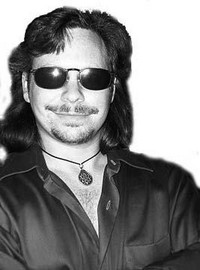
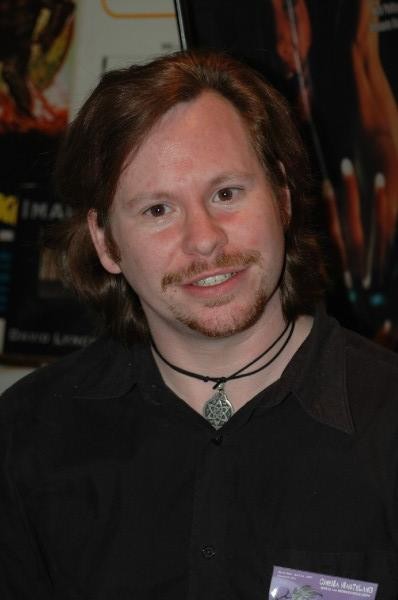
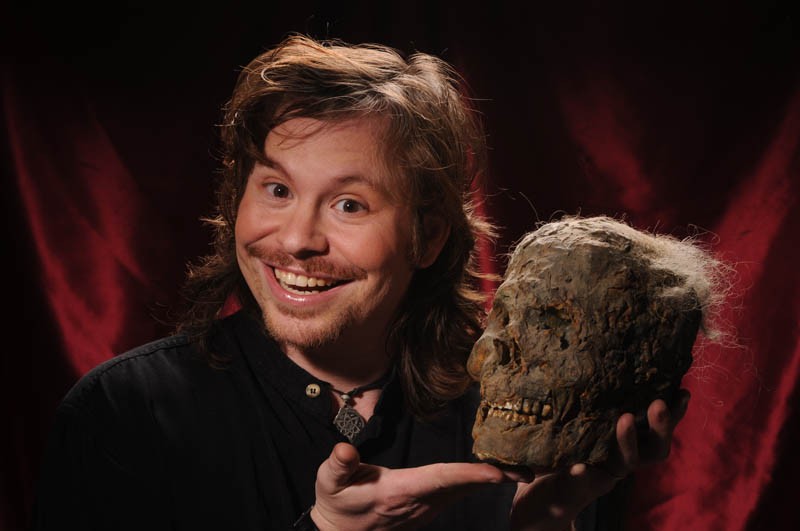
If you're a fan of cult genre cinema, chances are you've seen Happy Cloud Pictures head honcho Mike Watt's name pop up at some point. It seems he's worn just about every hat in the industry, both on the artistic end of things (as a writer, director, and actor) and the business end (as a publicist and producer). He's also a popular journalist (who's written for such magazines as Sirens Of Cinema and Film Threat) and novelist. He's done everything from scribbling the liner notes for the D.V.D. editions of cheap-ass Shock-O-Rama releases like SANTA CLAWS, to collaborating with George Romero's son Cameron on the script of 2007's THE SCREENING.
With his debut feature, a microbudget zombie horror/science fiction/film noir combo-platter entitled THE RESURRECTION GAME, finally getting the wide release D.V.D. treatment after years of delay (caused by everything from digital compression errors to the simple pitfalls that come with making a motion picture on your own damn dime n' time, Watt agreed to sat down for an e-mail interview, spilling his guts about spilling his actors' guts, and about what's next for this independent iconoclast.
An official D.V.D. release of The Resurrection Game has been a long time coming, and it's been pretty highly anticipated by those haven't seen it on bootleg. One thing people ask all the time is "why?" Why did it take so long to finally see the light of day in this final, official form?
From our presskit: "It took as long as it did to bring this film to completion for the simple fact that it was shot on film. Filmed between 1998 and 2000 on 16mm, the filmmakers then struggled to pay for the post-production. To cut corners, Watt hand-cut the work-print on an upright Moviola and, with best, also physically cut the negative for transfer to digital. From there, Watt recut the film digitally, matching the images to the temp dialogue mix track, then remastering the audio from the original Nagra masters."
In short, I cut this movie from beginning to end about four times (five if you count a hard-drive crash that destroyed the first telecine-to-audio match-up in 2005. For the definitive DVD, I also scrubbed through the final version and replaced a good number of sequences with the original telecine footage from the neg only to discover that these original tapes were recorded on LP by the lab that did the transfer (this was after destroying reel four with a processing error, resulting in all the little From Beyond amoebas floating around Emily Zarkoff during her exposition scene). So all the little glitches and archives I'd lived with for so long turned out to be in the source material. Which led to some intensive CGI painting to get rid of the worst of the offenders. So if you think the movie looks scratched and old now, you should have seen what I originally had to work with.
 Finally, Rich Conant took the final audio and reprocessed it to restore it the best he could, but we were still dealing with eight-to-ten year-old materials. ¼" magnetic audio masters-which I had to go through and find the correct takes to match to the neg as we only had enough money to transfer the conformed negative and none of the outtakes-hold up well, but not perfect. The last bit of fortune came in the form of Aaron Bernard who sent the whole movie through a up-converting digital processor that restored a lot of the bleached color and allowed it to finally pop again as it did when we first shot. Actually, it's a miracle this new DVD exists at all.
How would you describe the style of the THE RESURRECTION GAME, and its story, to someone who's not yet familiar with it?
Justin Wingenfeld, who made Skin Crawl and played "Mr. Black" at the beginning of the movie, gave us our best tag-line. He called it "L.A. Confidential meets Dawn of the Dead". We've been referring to it as a "zombie-noir" since the first draft of the script. Mike Gingold likes to refer to it as a "zombie movie without zombies". I directed the movie as a hard-boiled mystery first and a horror movie second. Actually, I barely even think of it as a horror movie. In truth, I don't think any of our movies are straight "horror" movies-we haven't made one yet. We just play within the loose structure of horror rules and see what else we can do in those constraints. And as it turns out, you can do a lot. With RES. GAME, I just wanted to explore themes of redemption and human resiliency. I don't care how fast these plagues can spread; I doubt the human race will die out that quickly. When I worked for Cameron Romero, he told me he thought Shaun of the Dead was sort of the prequel to our movie, with people getting used to the zombies quicker than you'd imagine. That's the playground I wanted to explore.

THE RESURRECTION GAME was your first feature-length film, and it was the impetus for the creation of Happy Cloud Pictures. Would you describe the experience of shooting the movie, and maybe tell us a little about how Happy Cloud came into being?
I'd just graduated from Pittsburgh Filmmakers with my degree in production. Bill had just finished his tours at The Art Institute of Pittsburgh and ITT Technical Institute. Amy had produced my senior film as well as a couple of shorts we'd done before graduation. We were sitting around and simply said, "Let's make a feature." That was all the thought that went into that decision. From there it was simply figuring out how. And that process continued until the anniversary DVD was processed. You don't learn how to make movies, only how to make the movie you're making. We chose the production company name after a slug line in the script, describing Godcorp's logo as a "happy cloud". Bill had already sketched up a variety of designs so we picked one for Godcorp and one for the company logo. Before the script was even finished, I took some pictures of Bill and Amy in their exterminator costumes (which were, for all intents and purposes, their own every-day clothes) and posted those to the internet, announcing the upcoming movie "Necromaniac" (as it was titled then). We managed to keep fan interest up until the first screening in late 2000, and continued to gain a cult following throughout its troubled history.
 We shot basically whenever we could and had the money. Everyone involved had a full-time job and a real life outside of this madness. All the equipment was provided through Pittsburgh Filmmakers via an artist membership, film wasn't cheap but I worked at the lab that processed it at the time so I was able to get discounts (among other things). The hardest part was just getting everyone together when we needed to. Some people could only shoot one weekend per month and sometimes that was all we were up for ourselves. Or sometimes that was the sole amount of film we had to use. A grant started us off with about 2000' of color negative 16mm, but after that it was: work for two weeks, buy 1600', rinse, lather, repeat. During the two years of shooting, our first Emily Zarkoff moved to Greece, which set us back requiring recasting; our D.P. Bill Fuller joined the Grip/Electric Union and got paying jobs, so he had to bow out; Amy and I got married midway through-which is a terrible idea. Do not plan a wedding and a movie at the same time. David Shremp, who played Tick, underwent brain surgery during the last stretch of the film and Bill wound up doubling his main fight scene, and sadly Dave passed a few weeks after our final wrap.
It was a long and miserable process, but we learned an awful lot during that time. It prepared us for each subsequent shoot-how to think on your feet when problems arise, how to shoot around peoples' schedules, how to stage a scene so that group scenes can be broken up and reformed in editing. The biggest trick we learned was to keep the costumes after each shoot. One character's shirt on a stand-in (a "Shemp" to steal from Sam Raimi) for an over-the-shoulder shot is the best movie magic you can learn. Producer Tim Gross stood in for nearly every character at one point or another-he has very versatile shoulders.
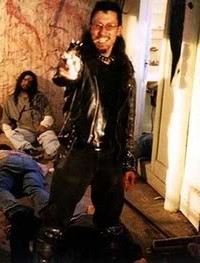
Obviously you've gone on to make several films since THE RESURRECTION GAME. What are some valuable lessons you think you may have learned from the production of that film, and in general over time?
See above for some examples. The key lesson we learned came from Tom Savini. He would ask himself and his students, "what do I need to see for this effect to work?" Obviously he was referring to make-up and prosthetics-build a hand and use a real body, for instance, rather than a whole body-but we applied it to everything we did. Someone needs to be stabbed, what do we need? A knife, but only this much of one, this amount of blood, this part of the body if the actor isn't available and this is only an insert, plus the infinite value of inserts. All editing benefits from how fast the human brain processes information, which can be a detriment to movies like Moulin Rouge but a huge benefit for effects and action movies. Your brain is still processing one shot when you cut to the next, thus the mind fills in the gaps and jumps. We've had over 100 years of experience with this-our brains have actually evolved to process movies like this. You can actually hide things within an edit, if you know how and where and when to cut. Which is something you can learn the basics of-and I was fortunate enough to have Tony Buba (editor on Martin) as an instructor-but you really learn by doing.
 If you apply this rule to every sequence, you find yourself working very quickly and creatively. The interrogation room scene in RES. GAME takes place in a completely dark, cavernous room. Where we shot, though, was only about 10 x 10. What do you have to see to get the idea of vastness? The answer was: nothing. So we lit with a key light straight over head and flagged off all the walls. Until the scene where Campbell's hand is crushed in the door, you never see the walls. That room could go on forever. Also, Campbell's apartment and Emily's house is the same exact set: the first floor of our house. Set dressing, closing doors, shooting different angles, avoiding showing the pattern on the floor, all of that led to the illusion that they were in different places. We've had people watch this movie a dozen times and not catch on until their last viewing.
Really, though, the best lesson is "start with a good script". That's the cheapest aspect of your production and it solves problems ahead of time. And if it's really good-interesting characters, clever dialogue, a tight plot-it will overcome technical deficiencies. Even the most-savvy, jaded critic will generally overlook mismatched lighting or a subpar performance if the story keeps him engaged. Don't skimp on your script and don't shoot your first draft. You'll wind up tearing pages out anyway.
Having made more movies since then, when you go back and watch THE RESURRECTION GAME, do you personally think it still holds up well?
That's difficult for me to say because I've personally lived with it nearly every day of my life for ten years. Amy and Bill were always involved-Amy cut the neg right there with me-and we all worked as a unit and three-person sounding board, but I did the majority of the editing, scrubbing, CGI, etc. I personally feel it holds up but I've lost any sense of objectivity. I ask that question a lot during the DVD documentary and I ask it of people much smarter and savvier than I am-Gingold, Scooter McCrae, Alan Rowe Kelly, Art Ettinger, Michael Felsher-and everyone seems to agree that it's still relevant and still innovative, even after 10-years' worth of zombie movies glutted the market. It still tells an off-beat story in its own way. Yes, there are plot holes you can drive a truck through, the same three people play zombies in every scene, but it still has something to say.
Although THE RESURRECTION GAME was made long before the recent "Zombie Boom" got underway and made it so that you couldn't even turn your head without accidentally watching a zombie movie, there is the fact now that the market has become highly saturated with zombie films. What do you think there is to The Resurrection Game that will help it stand out from the rest of the pack and make itself noticed?
 It's not just people running away from zombies, it's telling a deeper story than that. At its core, to me, it's about four people trying to do the right thing even though their instincts and cynicism tell them "fuck it, let someone else deal with it". And they're up against unwinnable odds, all four of them. While they all have their own reasons for joining the fight, they still forge ahead. You don't get that sense from a lot of mainstream movies any more-certainly not in anything more than a superficial way-so I'm very proud of that aspect of it.
But also, it has its own legacy. People who bought every version before-including the horrible VHS shot-off-a-flatbed-monitor-robot-epilepsy-theater version that was reviewed in Book of the Dead, Art Ettinger in Ultra-Violent, Mike Haushalter in Secret Scroll Digest, Jonathan Maberry's Zombie CSU, etc.-bought it again. It's still selling well, even as we're jumping through hoops to get it into the marketplace. Yes, every now and then we'll get someone who bought it just to say, "it wasn't that great and they shouldn't have wasted their time", but you're going to get that with any movie. (In fact, we look forward to our first written-in-crayon "worst movie ever" Netflix review because our numbers always spike after that.) But it still has its devoted fans and it still attracts people who will buy anything with zombies in them, no matter how few zombies there might be.
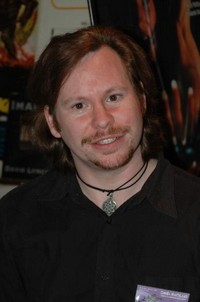 When I worked as a publicist, I realized that with any horror release, no matter what it was, you could usually count on reaching the same 3,000 people. 3,000 people who will support anything horror, independent and underground. Whether they have the money at the time or not is beside the point, the number is there. For an underground society, 3,000 people is a good number. Some religions don't have 3,000 members.
But really, at this point, I don't have to do anything. We already proved ourselves. We shot a feature-length movie, on film, that has been seen all over the world in one form or another. There was a fan-screening of Indonesia and it's been sold on the streets of Hong Kong with a Dawn of the Dead front cover and Necro-Phil on the back. If we never make another movie, we can say we did that much. I want it to sell a little better and I'd like to see it lead to bigger things, if only to get the last remaining cases out of the house, but if it doesn't, it doesn't. In the great scheme of things, we left our footprint in the sand already. The fact that people continued to talk about it even when they couldn't see it really does amount to something.
Despite it being only available in a few different bootleg versions, bootlegs of THE RESURRECTION GAME have circulated pretty widely. I remember when I read a short review of it in Jonathan Maberry's book Zombie C.S.U. and I got frustrated because I still couldn't get my hands on a copy of the damn thing. Are there any people or places that you were surprised to hear THE RESURRECTION GAME had turned up with?
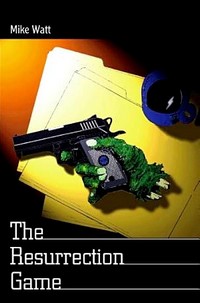 There was a weird little Borders exclusive called "Whack-a-Zombie", which came with a little book and an inflatable bop zombie. In the book, it mentioned The Resurrection Game's novelization as one of the best zombie books ever written. I have no idea who wrote this little thing and it led me on a little scavenger hunt. The first time I'd met Greg Nicotero, he'd somehow gotten his hands on the bootleg and enjoyed what he "was able to see". Cameron Romero-eldest son of the man who started this zombie business-had heard of me before I'd even met him, which led to our initial friendship. George was vaguely aware of it because a fan had sent him a copy that they'd bought from us for him. Whether or not he actually watched it, I have no idea, but I saw it sitting on his table during a signing. The Hong Kong bootleg stunned me, as did the Indonesian producer's admission that he'd seen it.
Now that the movie has been finally released with this 10th Anniversary special edition, and a lot of the people who never got the chance to see it before are finally getting to check it out, what kind of response are you hearing from fans? Is it living up to the expectations?
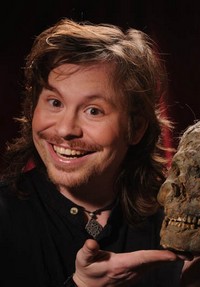
What's hilarious is now that it's out officially, we're finally getting bad reviews. For ten years, when it was just the 'little zombie movie that could', even people who disliked me personally gave it good press. But now that it's out there for the world to see, we're starting to see the backlash, like I mentioned above. Some of that might be because we have done four features since RES. GAME, so expectations were either high or reviewers feel they have to be negative now towards it. Or, to be perfectly honest, maybe it's finally moved beyond the folks who were predisposed to liking it for whatever reason-supporters, zombie fans, indie fans-and it's finally in the hands of people who just don't dig it for whatever reason. The people who like it still support it. It's found new fans, but it's also found people who are burned out by zombies, by indie stuff, by YouTube zombie videos, whatever. I'm perfectly okay with anyone who doesn't like it for whatever reason. As far as RES. GAME goes, we're bullet-proof. I'm thrilled if you do like it, but if you don't, you don't. It's no reflection on any of us as people or as artists. It's easy and glib to say "where's your movie?" but that's just defensive and reactionary. Really, as Project: Valkyrie's Jeff Waltrowski likes to say, "Everyone likes different stuff."
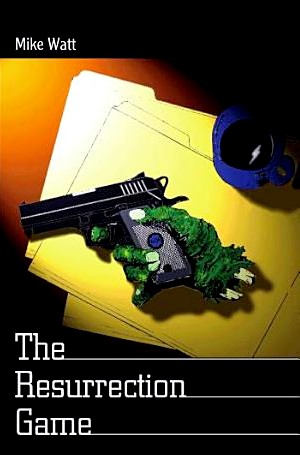
One thing that's definitely unusual and unique to THE RESURRECTION GAME is that it's an extremely low budget, independently produced, blue collar genre movie... with its own novelization, penned by you. How did the book version of THE RESURRECTION GAME come about, and how do you think it complements the movie as a sort of companion piece?
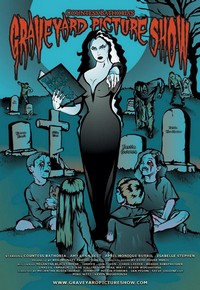 Every tie-in to The Resurrection Game was born out of desperation to keep it in the public eye. We did a comic adaptation of the basement sequence called The Dead Life, with seven different artists working off the script, and I did short-story adaptation of that script for an anthology called The Undead. Those were simply to keep reminding people, 'hey, there's a movie, we swear!' The novelization came about after I'd been working for a number of pro magazines and I attracted the attention of a pseudo vanity press called iUniverse. They sent me an offer to try their services and waived the set-up fee. At the time, print on demand was just taking off and I considered this to be another off-shoot of self-distribution. All I was doing was paying for their printing. But at the same time, the company made it available to Amazon and even brick-and-mortar bookstores at the time. So I took the basement scene short story and expanded it. At this point, I knew the script and story backwards and forwards, so it was no trouble to stretch it into novella length. I wrote most of it while working for Bruce Lentz at Incredibly Strange Video. When it was finally published, I bought a couple dozen copies, sold them at shows and that was it. Every year I'd get a royalty check for about $60 bucks, which told me people were buying it with or without me.
After finishing the anniversary DVD, I went back to the novel and fleshed it out for a new printing. We were having a good deal of success with self-published books-Phobophobia and my ridiculous Incomplete Works of Mike Watt are selling amazingly well. I'd had an outline for a sequel sitting in a notebook for years and my original plan was to rewrite the first then write the second and release it as a single omnibus. But Dr. Pus at Library of the Living Dead Press thought they'd make better stand-alone books. So even the novelization is getting a "director's cut" release next month, with the sequel due out in October. Romik Safarian has created brilliant covers for both books and I'm actually having fun revisiting that universe (plus enjoying the opportunities to plug in some of those plot holes that have been bugging me all these years).
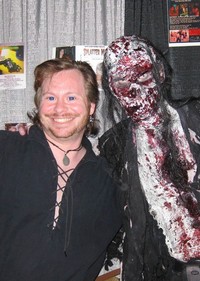
As far as complimenting the movie, the first novel is almost exactly the same, just wider. I devote a couple of chapters to the world around Campbell and how other people deal with the Infestation. The sequel explores that even more, with flashbacks to the first days of the outbreak and Godcorp's motivations and machinations. If nothing else, it added "novelist" to my resume.
After ten years of conventions, bootlegs, digital compression error, and people asking you over and over again why it's taken so long to get this movie out to the public, are you finally tired of talking about this damn film?
I pretend that I am-and sometimes I genuinely am-but I'm happy with it. We're all happy that it's finished and it's a nice tentpole for Happy Cloud Pictures. It opened a lot of doors for us. Amy's known all over the world as an actress, producer and a champion of women-in-horror, Bill is the unknown enigma because he stays out of the spotlight (despite marrying underground filmmaker Gwendolyn) and we get his fanmail, and I get at least one nice email every other day or so from people telling me that it "rocks". On the other days, I get a FB message that it "sucks". Either way, it's done and it's a big fucking relief.
Now that the final D.V.D. version of THE RESURRECTION GAME has just been realized, what else is going on in the Happy Cloud world right now? What can we expect in the future from you, Mike?
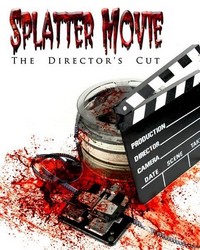 This is the big self-promotion section, eh? 2010 is Happy Cloud Pictures' 13th Anniversary and it's all going to culminate in September at Horror Realm in Pittsburgh and October at the bestest convention ever Cinema Wasteland. Between now and then expect to see the new novelization of The Res. Game, it's sequel After Strange Flesh through Library of the Living Dead Press; a Res-related DVD-R (free to anyone who sends in the little proof-of-purchase on the back of the DVD) with another couple of hours of behind-the-scenes footage, short films by producer Charlie Fleming and new interviews from the likes of Paul Scrabo (Dr. Horror's Erotic House of Idiots) and Michael Varatti (Ultra-Violent Magazine).
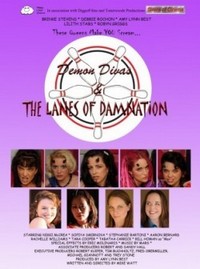
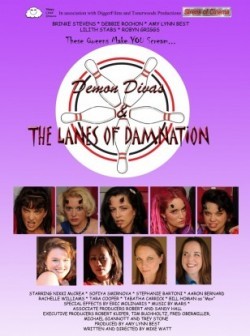
We're releasing our ode to '80s Scream Queen movies: Demon Divas and the Lanes of Damnation starring Brinke Stevens, Debbie Rochon, Amy, Robyn Griggs and Lilith Stabs, which has gotten a lot of people very excited.
Amy will appear in George A. Romero Presents Deadtime Stories which should hit eyeballs this year (check with the venerable Jeff Monahan for that); I'm contributing to season 2 of Forbidden Pictures' Chainsaw Sally Show, as well as working on the next installment of Michael Apice's Europa's Cry novella series.
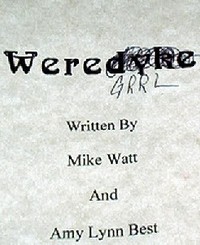
There are also a number of screenings in the works, including a Pittsburgh-based retrospective of our work. I'm talking to f.p.s. Films' Terry Thome about that as we speak. Plus, we just went into talks about doing a "big" feature-possibly our first "real" horror film, even though it's also horror-plus-something-else-for a bigger budget than we've ever had before. Which is, of course, terrifying. For more info, keep checking in with us on Facebook and at www.happycloudpictures.com
Well, it looks like there's quite a lot on the plate for Happy Cloud Pictures' founding members these days, eh? And in all these ventures, there exists a detectable, delectable strain of independence, imagination, and individuality. One need only look as far as Mike Watt's first feature, THE RESURRECTION GAME, to see that this is not a man interested in imitating or cashing in on bankable trends. Instead, this is a professional writer and director interested only in doing what he loves and believes in. Sci-fi zombie kung-fu mystery movies with heavy doses of sociopolitical commentary may not be what the masses are howling for, but they're what the voices in Watt's head demand to see. Some might say that microbudget movies "never" get novelizations. Those people never met Mike Watt.
As time passes and the Happy Cloud family and filmography both hopefully continue to grow, there is one thing you can almost definitely count on, and that's the fact that few others in the underground genre movie scene have ever been able to scare up the volatile combination of carefully honed filmmaking skill, exuberant enthusiasm, down-to-earth realism, genuine intelligence, and raw creativity that Watt displays. Whatever he does next, this much is certain: it will be a unique.
Until next slime...
Stay sick!
Your pickled pal,
William Weird.
|
 william