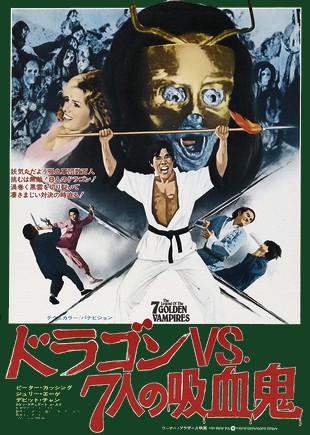
THE LEGEND OF THE SEVEN GOLDEN VAMPIRES (1974)
Starring Peter Cushing, David Chiang,
Julie Ege, John Forbes-Robertson,
Robin Stewart, Szu Shih, Shen Chan
Directed by Roy Ward
Baker & Chang Cheh
Written by David Houghton

It was the end of the line for Hammer Films. The UK production house whose very name was a byword classic gothic horror in the Technicolor age was by the 1970’s crumbling. The times had long since moved on, and despite their best efforts they had singularly failed to keep up. They’d tried bringing Dracula into the modern world with Dracula AD 1972 and The Satanic Rites of Dracula; they’d sexed things up with the Karnstein Trilogy (see BtZ#4). But this last ditch effort to break new ground resulted in such an off-the-wall concept that even the eternally professional and humble Christopher Lee – who, despite his misgivings, had stuck with Hammer and the role of Dracula through thick and thin - finally told them, “oh fuck off, I’m not doing that.”*
And what a pity that he did so. For while the movie in question may have wound up Dracula’s swansong for Hammer and probably had disaster written all over it from the get-go, it proved to be one of their most memorable and entertaining efforts. They might have had no clue what the hell they were doing, but by accident or design The Legend of the Seven Golden Vampires, or The Seven Brothers Meet Dracula as it has sometimes been known, actually did succeed in breaking new ground by giving birth to a new subgenre: the kung-fu horror movie.
But this was not only a meeting of genres – it was meeting of production houses who were titans in their respective fields. Hammer were approached by the Shaw Brothers, pioneers of martial arts movies, who with humility worthy of the Shaolin suggested that their powers might be greater combined. So those very British filmmakers upped sticks from the Berkshire estate which had served as home for two decades, and shot for the first time in China. The result was naturally something a bit less quintessentially British than usual, yet it’s still unmistakeably Hammer.
The set-up is every bit as absurd as you’d expect. Dracula – in the ill-fitting body of John Forbes-Robertson – is visited by Kah (Chan Shen), an evil dude from China, who has come to seek the Count’s help in resurrecting the titular seven, a bunch of super-evil super-villain vampires from his home village. Not taking kindly to the cheeky scamp’s demands, but realising that his new Forbes-Robertson look isn’t doing him any favours (I mean, the bugger’s got so much greasepaint on he looks like a drag queen), Dracula decides a change of scene might do him some good and so shanghais (damn I’m witty) Kah’s body, then heads off to China to resurrect the Seven Golden Vampires anyway. Why? Because he can. He’s Dracula, for fuck’s sake. And it’s certainly not the least logical behaviour he ever demonstrated in the Hammer movies; witness the near-Dadaist incomprehensibility of Scars of Dracula.
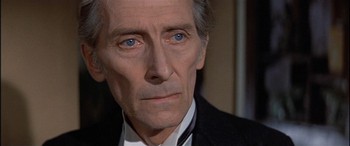
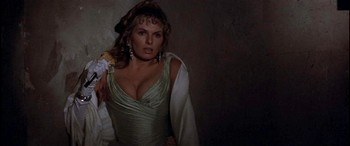
 Anyway, some time thereafter Professor Van Helsing (the ever-reliable Peter Cushing) is in China lecturing on vampirism, much to the derision of the local academics. But one among the audience does believe the Professor’s pseudo-scientific psychobabble: Hsi Ching (David Chiang), who – surprise, surprise – has also come from the village of the titular seven, to seek the famous vampire killer’s help in dispatching the super-evil super-villain vampires. ** Along for the ride is dapper young man-about-town Leyland Van Helsing (Robin Stewart) – making this the only movie I’m aware of in which Van Helsing has a son - and Vanessa Buren (Julie Ege), a shapely blonde European heiress in search of adventure and emancipation. Off they head across the rocky plains of China, and unsurprisingly prove to be of absolutely no use in the numerous kung-fu confrontations along the way. It’s left to Ching and his siblings, including their sister Mai Kwei (Szu Shih), to kick much arse and give the movie its edge.
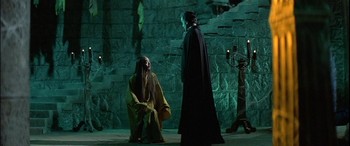
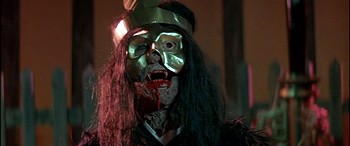
 The Seven Golden Vampires themselves are not exactly the most formidable monsters you’ve ever seen; with their flaky corpse physicality and cosmic rock getup, they look less like typical Hammer vampires than Fulci zombies on their way home from a Hawkwind gig. And as far as being golden goes, all they’ve got to show for it are Kato masks and oversized bat medallions that look like they’ve been spraypainted that colour. I’ve seen more genuine looking bling on the scallies in Liverpool city centre. But credit where it’s due, they (the seven vampires, not the scallies) command an army of skull faced living dead who do their dirty work, which mostly consists of kung-fu fighting and seizing young women from the village.
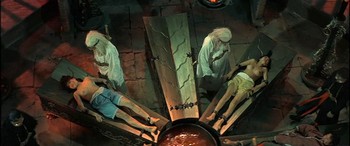
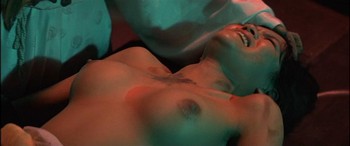
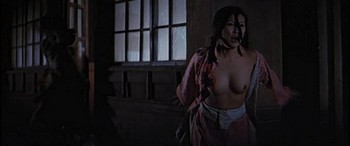
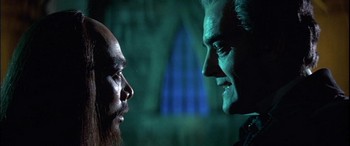 Naturally, being evil vampires, the seven are partial to having pretty maidens sacrificed in their name; in their headquarters (which I like to call Pagoda Dracula) there’s a neat little altar set up with the seven vamps all in a circle, each with a screaming girl tied down to a slab in front of them. Fascinatingly, though there are a few sacrifice scenes, never more than three of the victims at a time are topless. Who knows, maybe three of the evil seven favour the boobies more than the other four. There’s even a not-remotely-gratuitous moment in which mid-kidnap a village girl’s top is ripped off, and she proceeds to stand still for about five seconds so we can have a good look before she finally flings a defensive arm across her chest. Still, unlikely many of the late Hammer movies, this one has more going for it than female flesh; hell, Delia Lindsay’s arse shots are about the only thing that makes Scars of Dracula worth watching. LOTSGV, on the other hand, has boobage AND kung fu. Now we’re talking.
 It may meander a bit along the way, with a little too much superfluous exposition and backstory - which Cushing, to his eternal credit, makes credible with ease - but plenty of cans of whoop-ass get opened along the way, particularly in the final battle sequence. I’ve read reviews that have criticised the direction, saying Roy Ward Baker had no idea how to film martial arts, but I must disagree. Look at the credits and you’ll see the crew was proportionately more Chinese than British; the simple visual style is reminiscent of the martial arts films of the era and captures the action just fine, even with the odd glimpse of Cushing or Julie Ege standing ineffectually in the background and Robin Stewart feebly attempting to get in on the action. In any case, the fight sequences were almost certainly the handiwork of uncredited co-director Chang Cheh, the man responsible for such Shaw movies as One-Armed Swordsman. There’s plenty of swooping, leap-frogging, high-kicking and all that jazz. It’s not quite Drunken Master, but it gets the job done.
 And at the risk of coming off a big girl’s blouse (stop sniggering), I’d be doing the movie a disservice if I didn’t mention the two nicely understated love stories. Considering that the early scenes clearly show Leyland to be sexually interested in Vanessa, it’s a pleasant surprise as later on we find him gravitating toward Mai Kwei, and she toward Hsi Ching. Both relationships are handled in a delicate and, believe it or not, entirely convincing fashion. And it all builds up to one of the most memorable moments in the movie, in which a pair of lovers - I won’t say which, in the hope of keeping the uninitiated in suspense - have been infected by the vampire bite, and the two of them die together on the same wooden stake. It’s one of those classic tragic moments that have kept the gothic vampire love fantasy alive for generations, and almost certainly inspired a similar moment in Blade 2 (Guillermo Del Toro has cited LOTSGV as an influence) in which a pair of vampire lovers are turned to ash in the same shaft of sunlight. Indeed, it may be the most touching cinematic display of interracial romance outside of 2 Fast 2 Furious...
 In all seriousness though, Legend of the Seven Golden Vampires is in many respects a truly pivotal movie in genre history. It closed the book on Hammer (they made a couple more lacklustre movies before fizzling out completely, but nothing in their signature gothic niche) and gave Peter Cushing - the screen’s greatest Van Helsing - his last turn in the role. But it also paved the way for the horror/action/fantasy crossovers of the future, both in the east and the west. I don’t think it’s too much of a stretch to assume that without it we probably wouldn’t have Big Trouble in Little China, Mr Vampire, Encounters of the Spooky Kind, Buffy the Vampire Slayer, Blade, Underworld, Versus or countless others of that ilk. So if you’re seeking a little supernatural-flavoured chopsocky entertainment, do yourself a favour. Steer well clear of the piss-poor Blood: the Last Vampire. Track down Legend of the Seven Golden Vampires, and see how fang-fu got started in the first place.
 (* Naturally I have no actual evidence that Christopher Lee ever said anything to this effect, but can’t you just imagine it? That big booming baritone voice of his going “fuck off!” Hmm... is it just me or is that kind of sexy?)
(** Don’t you just love how it always works in these culture-clash films - the lowly foreigner has to come to the English or American man for help, regardless of the fact that more often than not said English or American man winds up being of little or no assistance. Heaven forbid the western superpowers should have their delusions of superiority threatened. Jack Burton in Big Trouble in Little China is a clear parody of this, to Carpenter and Russell’s credit. But in case you think we’ve progressed since then, take a look at Tom Hanks in the Robert Langdon movies.)
|
 ben
ben