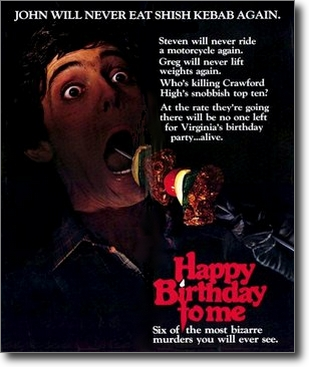
 Much has been mentioned of the connection between Sean Cunningham’s FRIDAY THE 13TH and Mario Bava’s BAY OF BLOOD, with an emphasis on the likely influence the latter had on the former, despite Cunningham’s claims otherwise. When I recently rewatched BAY OF BLOOD, it got me thinking about the overall influence of the Italian giallo on North American slasher film, and, though I love both genres, I fail to see much of a real connection. In a sense, slasher films are a degradation of gialli: they reduce complex murder mysteries full of sex, gore, crime, and adult themes down to much flimsier plotlines about sexually active teenagers getting hacked to pieces, with some puritanical morality thrown in for good measure. And then I saw HAPPY BIRTHDAY TO ME.
As far as ‘80’s North American slashers go (and I have to say North American, because the film is from Canada), HAPPY BIRTHDAY TO ME is fun, unpredictable, and occasionally confusing. Overall, it blew my mind. And I said to myself, “Holy crap! The director must have seen Argento’s TENEBRE!” Well, whether J. Lee Thomspon has seen TENEBRE or not, I cannot say, and it doesn’t really matter, because it came out a year after HAPPY BIRTHDAY TO ME (1981). Regardless of the influence being impossible, there are a lot of unlikely and unusual visual and thematic links between the two films that are worthy of some exploration.
As I mentioned, HAPPY BIRTHDAY TO ME was directed by J. Lee Thompson and released in 1981. It stars Glenn Ford (!) and Melissa Sue Anderson, was written by John C.W. Saxton, and richly deserves the somewhat obscure cult status it has reached over the years. A combination of typical American slasher, more bizarre European fare, insane plot twists, and an underlying air of the macabre set this apart from it’s scantily clad, blood-soaked brethren. While it retains the trashy-yet-entertaining vibe of other slashers, it has… something else, too.
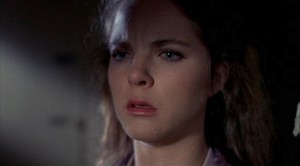
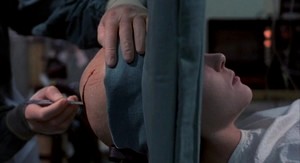 The film concerns Ginny, who, though she and the rest of the cast appear and act as if they are college students, is a recent re-arrival at the local prep school. She is part of the popular crowd, known as the Top Ten, who represent the richest and most popular teens in town. Mysteriously, they begin dropping like flies, with completely unpredictable death scenes that have no MO (modus operandi; in other words, common signature). The murders are bizarre, funny, and, occasionally, only practical jokes. There is a malignant joking strain that runs through the Top Ten, and even though their friends are being murdered, the teens still play tricks on one another and maintain a light-hearted air of unconcern. It becomes obvious that Ginny is responsible (though initially the killer is given a first-person camera view, we eventually see her commit the crimes), and that a past trauma is likely responsible for her mad rampage. But what is this trauma that she cannot remember? And is she really responsible? As her friends die off, as her headaches and blackouts get worse, and as reality begins to crumble around her, Ginny struggles to find out the truth.
And beware, for here be spoilers. I can’t compare the two films without absolutely giving away the twist endings of both.
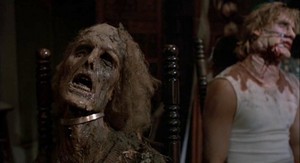 As it turns out, Ginny’s trauma is that, several years prior, the rest of the Top Ten refused to come to the birthday party her bitter, alcohol mother organized. She was invisible to her classmates, presumably because of her mother’s blue collar, colored past. Her sloshed, humiliated mother decides to confront the absent guests, who are at another party, and during the drive gets into an accident that kills her and gives Ginny an almost lethal brain injury. Ginny spends years undergoing experimental surgeries and medications. Finally, she and her (mostly absent) father are able to return to their home town, where she will presumably confront the ghosts of her past.
It is clear to the audience that Ginny commits her crimes during some sort of blackout, where she is not conscious of her actions. Towards the end of the film, when she fully remembers the traumatic night of her birthday party, she realizes with horror that she is the one responsible for the murders. She confronts her psychiatrist (Glenn Ford), who she has been more and more hysterically communicating with throughout the course of the film. When he cannot give her any answers, she kills him in a fit of psychosis/terror/confusion. Next, we see that she has made a gruesome recreation of her earlier birthday party. She wears the same dress and all the guest are there, though dead, including her decayed mother, and she is singing and ready to cut the cake when her father arrives. He laments the fact that his career has forced him to spend so little time with her, and blames himself for her atrocities. She kills him in the same detached state that she has committed the other murders.
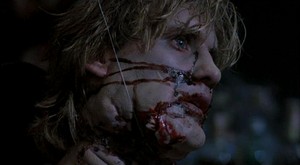
Then we discover, with much confusion and surprise, that there is another Ginny, unconscious, in a chair by the cake. Ginny number one and Ginny number two have a verbal confrontation, whereby the standing Ginny pulls off a mask (!!!) to reveal that she is Ann, one of the Top Ten thought to be murdered, and Ginny’s closest friend. Apparently Ann was traumatized by the fact that she and Ginny share the same mother, because Ann’s wealthy, prestigious father had an affair with Ginny’s unstable, unworthy mother. It has been her life’s pursuit to get rid of Ginny and utterly ruin her life, which she accomplishes, in spades. As Ann prepares to kill Ginny with the cake knife, Ginny fights for her life, stabbing Ann in the process. The sheriff immediately enters, coming to the obvious conclusion. Wow. It is such a major twist, that, after all the red herrings that occur during the film, one’s brain almost cannot process it. If it were not for the more complicated themes that the film addresses (like identity, the affect of the past on the present, and the cruelty and decadence of the rich), the ending would seem like an absurdly graphic Scooby Doo episode.
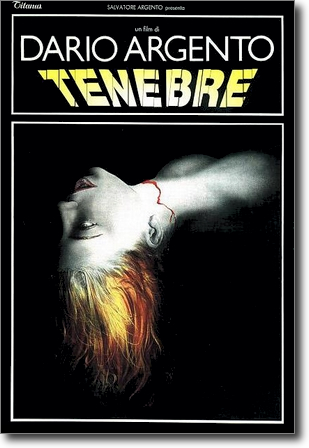
 Not to be outdone in the unbelievable-twist department, Dario Argento’s TENEBRE is another film that belies imagination and visual comprehension with it’s conclusion. TENEBRE also marks Argento’s return to the giallo after a number of supernatural horror films. While SUSPIRIA and INFERNO are two amazing films, Argento got his start in giallo (BIRD WITH THE CRYSTAL PLUMAGE, etc), and I think this is where he really shines.
Released in 1982 and starring Anthony Franciosa, horror favorite John Saxon, and Argento regular Daria Nicolodi, TENEBRE concerns an American author, Peter Neal, who gets involved in a series of unusual murders while he is in Rome publicizing his newest novel, the aptly named Tenenbre. The murderer is inspired by Neal, committing crimes directly lifted from the pages of his newest, quite violent murder mystery. The Roman police initially investigate him as a suspect, but soon turn to his expertise (?) when they realize the motives of the killer are beyond them.
Much of the film cuts back and forth between Neil promoting his novel, his interviews with the police, and the violent murders. He starts out in New York, where his luggage is stolen and ruined by his angry ex-wife, Jane, who, unbeknownst to Peter, follows him to Rome. In Italy he is met by his agent (Saxon), his assistant (Nicolodi), and is given another young Roman assistant, Gianni. As he arrives, a pretty young shoplifter is sadistically murdered by an unknown, black-gloved killer. Pages of Tenebre are shoved into her mouth, and Peter receives an anonymous letter from the murderer. He contacts the police (Detective Giermani) and is sucked into the investigation.
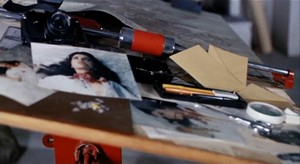
Soon, the black-gloved, razor wielding killer strikes again, this time murdering a lesbian journalist and her partner, hours after she interviewed Peter. Again the murders are stylized and violent, with ripped pages of Tenebre left in the women’s mouths. Maria, the daughter of the owner of Peter’s hotel, is murdered next. She accidentally comes across the killer’s home, stumbling into his basement to avoid being attacked by a dog. Horrified by what she finds, she takes a few photographs as evidence until she found by the killer.
 Shocked, but interested, Peter and his second assistant decide to stake out the home of Christiano Berti, a reporter with an obsessive interest in Tenebre and Peter’s other novels. The two men get separated and Gianni watches in horror as Berti is axed to death in his own home. Gianni doesn’t get a good view of the killer, but finds an unconscious Peter sprawled out in the backyard.
The police reveal that Berti was the murderer, though there are no clues as to who killed him. Meanwhile, there are a series of strange flashbacks involving a beach, a cruel woman with red high heels, sexual humiliation, and murder. Soon Peter’s agent is stabbed to death in broad daylight, reopening the investigation. Gianni believes he knows something important, and returns to Berti’s house to jog his memory. He remembers that Berti confessed, but before he can reveal anymore he is strangled to death by an unknown assailant hiding in the back of his car.
Jane, Peter’s ex-wife, is graphically murdered with an axe… by Peter himself. Apparently the flashbacks were Neal’s memories: he was a very sick teenager who killed a woman and, presumably, blocked out the memory of it. Berti’s murders triggered the impulse in him again, making him completely insane. Peter kills an inspector who arrives on the scene, and kills himself in front of his assistant Anne and Inspector Giermani. Anne, who is traumatized, goes to wait in the car, leaving Giermani alone with Peter. It appears that Peter used a trick razor and faked his own death, allowing him to sneak up behind Giermani and murder him, in an incredibly creepy scene. When Anne returns, Peter is waiting to murder her too, but she accidentally knocks over a metal sculpture that impales and kills him instantly. Anne screams over and over again into the night.
While I would argue that HAPPY BIRTHDAY TO ME is more of an entertaining cult film and TENEBRE is a classic of the genre, there are a number of interesting similarities between the two films. Some of the major themes of TENEBRE are also present in HAPPY BIRTHDAY TO ME: brain trauma, the events of the past coming back to haunt the present, sinister doubles, main characters who have difficulty with personal relationships, obsession with materialism, flashbacks, the failure of vision (both on the part of the audience and the protagonist), and a pervading air of the grotesque.

I think the most important feature represented in each film is the double. In TENEBRE, Peter doubles Berti and Giermani. In a tricky bit of writing, he is asked to help solve the crimes, which then triggers his urge to commit them. Though his identity is heavily fractioned, in a certain sense he outshines both his doubles. He is able to make the inspired leaps of logic and reasoning that Giermani is not, and in fact solves the case before Giermani even has a suspect. And though Berti is an accomplished killer, using the patterns and modes typical of a serial killer, Peter, at least to the audience, is more terrifying. Each murderer claims the same number of victims, but Peter’s crimes are far bloodier, and scarier, because they are so unexpected. In HAPPY BIRTHDAY TO ME Ginny has a literal double: Ann. Though neither we nor Ginny know it until the end of the film, Ann has been disguising herself as Ginny and committing ghastly crimes. For most of the film, it simply looks like Ginny doubles herself; she has a happy, warm side to her personality, and a troubled, sociopathic side. The fact that most of the film operates under the assumption, makes the ending that much more jarring. We believe that Ginny is murdering because she is sick, but we come to find out that both Ann and Ginny are sick. While Ginny has blackouts and headaches from her brain surgery, Ann has a much deeper personality crisis. She literally steals someone else’s identity (her biological sister’s) to murder under the guise of revenge.
 Much of this doubling occurs because of past traumas that have resurfaced in the present. Both Ginny and Peter suffer from flashblacks. In Ginny’s case, we don’t know why she has blocked this event from her memory, or why it is important to the murders. With TENEBRE, we don’t realize that the flashbacks are Peter’s until the end of the film. It is apparent that whomever is having them is insane and definitely the killer. It is also obvious in both films that the flashbacks are directly related to some sort of brain trauma. Ginny has memories of being in the hospital, of having experimental surgery, and numbing pain. The flashbacks in TENEBRE are accompanied by visuals of a swollen, pounding brain, a man screaming in agony, and someone taking a variety of pills. The psychiatric troubles implied in both films seem to be instigated by the flashbacks in some way, though in either film we do not discover exactly how until the conclusion. The mental problems Ginny and Peter have also manifest themselves in the characters’s relationships with others. Though they both appear to be friendly and happy on the surface, neither character has any particularly close relationships. Peter has employees that he is kind to, but even Anne, his assistant in love with him, is an object of manipulation. His ex-wife appears both bitter and crazy; did she start that way, or did Peter do something to her? And though Ginny has a loving father and begins to have a boyfriend, a distance is always maintained. She remains an outsider, despite her attempts to fit in.
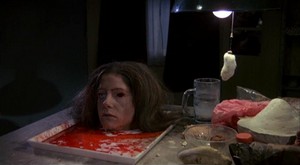
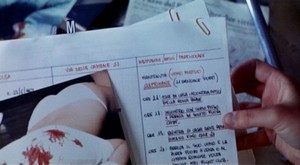 Another major element of HAPPY BIRTHDAY TO ME and TENEBRE (as well as most gialli) is the problem of vision. In both of these films, seeing is not necessarily believing, and what the eye records can easily be misinterpreted (a big factor in both of Argento’s earlier classics, DEEP RED and BIRD WITH THE CRYSTAL PLUMAGE). We see Peter Neal with a concrete alibi for some of the early killings, and we immediately rule him out as a suspect. Later, we see him kill himself, thinking it all to be over. In HAPPY BIRTHDAY TO ME we see, for a fact, that Ginny is killing her friends. We see Ann dead in the bathtub. Though this is a pretty common tactic of giallo films, it takes a more bizarre twist in TENEBRE and HAPPY BIRTHDAY TO ME, because of the double killers. The audience is not only duped, the characters, and frequently the protagonists themselves are. In TENEBRE, Gianni knows he has seen something, but can’t break down and process his own memory. In HAPPY BIRTHDAY TO ME, Ginny and the audience both think they have seen the dismembered head of a girl, the floating body of another dead girl, and the death of a boy. While the first girl is really dead, the visual evidence turns out to be a practical joke, as does the boy’s death (though he is killed later). The girl floating in the pool turns out to be something witnessed only by Ginny, who cannot trust her fragile sanity. The problem of vision is even more compounded by the use of first person POV. All the victims see their killers, but the audience is denied this knowledge. In the agent’s death in TENEBRE, and all the deaths in HAPPY BIRTHDAY TO ME, the killer is a trusted friend. This proves that not only can you not trust the hard evidence you are being shown, but the characters cannot trust the assesments they have made of other characters, and anything becomes possible.
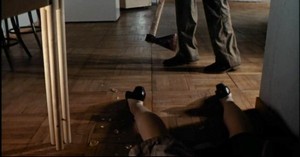 Finally, both films are pervaded by a strange air of the grotesque. In a typical horror film (using HALLOWEEN as an example), when the main characters learn of murders, they are alarmed and scared. In TENEBRE, the characters, especially Peter Neal, treat it as a game. He hopes to figure out who the murderer is before the police, proving his intellectual prowess. The other characters abet him in this, theorizing on ideas and clues, even risking their lives to get involved. They are all big fans of Peter’s novels, despite the gruesome subject matter, and they treat the murders like scenes from a book. Even Inspector Giermani does this; in a conversation with Peter, he discusses the plot of Peter’s last novel in the same breath as he does the killings. In HAPPY BIRTHDAY TO ME, the group learns that their friends are disappearing (and eventually being murdered), but they refuse to take it seriously. They play pranks on each other, pretending either to be dead or to be murderers. Before anyone really clues in and gets scared, they are all dead, propped up at a birthday table.
Though these films are obviously from separate countries, writers, and directors, and were released too closely together to have any major impact on eachother, the similarities are fascinating. Though there are a handful of films where protagonist and killer are one and the same, it is interesting that TENEBRE and HAPPY BIRTHDAY TO ME share this feature, as well as many other major themes, both in writing and cinematography. Rather than one borrowing or reimagining the plot of the other (as in FRIDAY THE 13TH and BAY OF BLOOD), they are coincidentally similar, mirroring each other unconsciously and unintentionally.
|
 samm
samm