|
|
Töres dotter i Wänge
Tore’s daughter in Vange deep
Did one morning too long sleep;
Mass she missed, she slept it thro’.
But God will surely bless her too.
To the loft Mistress Martha goes
- cold is the forest air -
Karin, her daughter, she arose,
- When green the trees are there.
Her daughter wakes with eyes awide
Prepares to Kaga Church to ride.
Proud Karin sits upon her bed
Platting her golden locks about her head.
Proud Karin dons her silken robe,
A work of fifteen maidens sewed.
Proud Karin dons her blue cloak bright,
She rides to church now it is light.
She rides around a giant tree,
Now three herdsmen does she see.
They say to her, “Come be our wife,
Or thou shalt forfeit thy young life.”
“Do not lay a hand on me,
Or my father’s wrath ye’ll see.”
For thy kinsmen care not we,
We’ll kill them all as well as thee.”
The herdsmen three took her to wife
And then they took from her her life.
They took her by her golden hair
And dragged her ‘neath a birch tree there.
They took her by her golden head
And left her ‘gainst a birch tree, dead.
And on that spot her body lay,
Burst forth a spring, so legends say.
They stripped her of her golden robe,
Into their bundle was it stowed.
Her body in the mire they lay
And with her garments went away.
When this foul deed had they done,
They took the way that she had come.
They went along that wooded lane
Until they Vange Village came.
They came up to the farm of Tore
And found the farmer at his door.
Tore stood outside all clad in hide,
He came and let the men inside.
Then went they into Tore’s homestead,
Where they partook meat and bread.
A thought in Tore’s mind did turn:
Why does my daughter not return?
Ere Martha joined her man in bed,
The herdsmen came to her and said:
“Wilt thou have this silken robe,
Upon which some nine maidens sewed?”
Martha saw the robe in horror,
It filled her heart with deepest sorrow.
Martha kept herself from weeping.
Approached her man who was sleeping.
“Awake now, dearest husband mine,
For they have killed daughter thine.”
“They have her robe, I know her fate,
This strikes my heart a blow so great.”
Tore to avenge his daughter’s life
Rushes on the men with unsheathed knife.
He kills one, he kills another,
Now he falls on the little brother.
Now Tore casts his knife away.
“O Lord, forgive my deed this day.”
“How can I this deed atone?
To God, I’ll build a church of stone.”
“Gladly shall we do such work
- cold is the forest air -
Karna shall we call the kirk.”
- When green the trees are there.
|
|
|

With the recent release of the Last House on the Left remake, a whole new generation of fans is being drawn to the 1972 version. In February, a new, special edition DVD was released of the original film, allowing fans new and old to enjoy the original again, and this time with more special features. While the remake lured fans and newcomers into theaters, and the new DVD called collectors and Last House junkies to the nearest Best Buy, what was going on with the 1960 version of the film? What attention was the Virgin Spring getting? Believe it or not, the original Last House is a remake itself of a Swedish film that got its origins directly from a 13th century Scandinavian poem. Who would have thunk that it's taken eight or so centuries for the Last House on the Left story line to become what it is today?
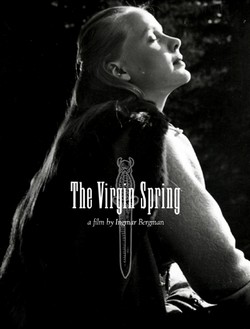
Swedish film director Ingmar Bergman made the Virgin Spring in 1960, and based it nearly scene for scene from a poem titled "Tore's Daughter in Vange." Of course, he added an extra character for drama and plot enhancing purposes, but it was worked in quite well. The film tales place in the Middle Ages and revolves around two main characters, a servant who is pregnant out of wedlock and an innocent but lazy girl named Karin. One day, on the way to church, Karin and the servant are met by three herdsmen, three brothers; two older, one a child. Karin is savagely raped and murdered in the woods, while the servant witnesses the whole thing, and the herdsmen take her clothes on the road to exchange for a place to stay. Little do they know, they end up taking that cloak to the home of Karin's family, and when her parents find out what happened, all hell breaks loose, and her father kills them all, including the child. After the servant leads the parents to Karin's body, the father decides that a church should be built on the spot where she was murdered to make up for the wrong that he and the swineherds have done.
Not even a decade later, Wes Craven directed the first Last House film, and did for the Virgin Spring everything that a good remake should, except credit its original for the ideas. The original Last House took the Virgin Spring, made it time appropriate, put a spin on its theme, but kept it true to its roots all the same. Wes Craven transformed the swineherds into serial rapists and murderers who just escaped from prison. The younger brother became the drug-addicted son of Krug, and Sadie was added to the group as a badass female character. Mari Collingwood replaces Karin, and she and a friend are captured, raped and murdered on their way to a concert. This time, when the team shows up at the Collingwood home, Mari's mother too takes a hand in getting justice for her daughter, instead of the father only. The concepts and the characters still hold true in this film, except the murders that the parents commit are much more ruthless and guiltless, and without consequence.
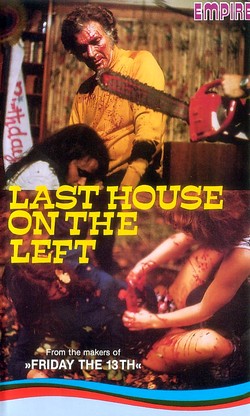 Only a few months ago, a remake of the 1972 Last House on the Left was released, and whether or not it keeps the story intact, changing it up to make it an original remake is debatable. The film attempts to do something completely new with the concepts illustrated in both the original Last House and the Virgin Spring, removing a lot of what made those films utterly ruthless and turning them into something more inspirational. In this version, the killers are given a motive, and Krug's son is made into a somewhat good character who is willing to help the victims of his father and company's crime. While a murder still takes place in the woods, and the Collingwoods still get their revenge, it is a much more emotional feat than it was in the original. The characters are all disturbed, and the parents seem reluctant to give the gang who raped their daughter what they deserve. The film overall ends up being much more about faith, family, love and strength than it really is about murder and guiltless vengeance.
Over the past 800 years, the tale that began as one of great sorrow and guilt has been transformed into one of ruthless murder and vengeance, and it now is a story of the overcoming of obstacles through collaboration and strength. What began as a foreign prestige film by one of the best foreign directors of all time was turned into one of the most successful mainstream films among exploitation film fans. And now, the most recent installation is a must-see for current mainstream horror fans who want to feel good when they leave the theater. It is hard to say whether or not this film will ever be adapted again, but it is no doubt that its timeless themes of murder and vengeance will be present in the horror and exploitation genres for years to come.
|
 gina
gina