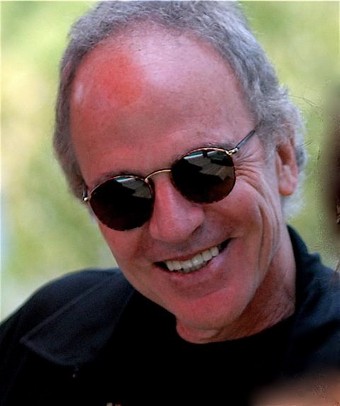

Although he possesses a list of credits that may not seem overly impressive to the undiscerning eye, Jeff Lieberman is the cinematic craftsman behind four very solid entries into the horror genre. I am not sure whether he will ever enjoy an enduring legacy, as even some fairly dedicated genre enthusiasts I have encountered seem to have glossed over the impressive writer/director in their travels through the world of horror filmmaking. However, he has not slipped under my radar, and it is my hope to bring his work together into a cohesive whole, because while many horror fanatics do not know the name, I suspect that most are familiar with at least one or more of the man's films.
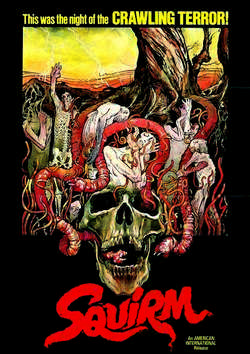
The Brooklyn-born Lieberman started out far from home with his first genre effort, the Georgia-lensed nature-strikes-back drive-in flick SQUIRM, which defies its low-budget roots with a fairly clever script and a few gruesome scenes of flesh-starved earthworms doing some seriously irreparable skin damage to several unfortunate souls. This admittedly silly story actually starts with a small kernel of truth, basing the genesis of its unspeakable horrors on a true phenomenon, namely, the tendency worms have to come to the surface en masse during rain storms. The difference here, though, is the electrical nature of this squall, which puts a charge into the air (apparently), but more specifically, downs some power lines, leaving an inordinate amount of juice in the soil. Of course, as we all learned in 9th grade Earth Science (or was it 10th grade Biology? I can never remember which), any time you expose regular earthworms to electrically-charged dirt, it drives their little worm brains insane with both rage and an insatiable hunger for flesh, and triggers their war nerves, resulting in their ability to hunt humans in packs. Finally, this phenomenon allows them to grow teeth strong enough to remove chunks of flesh from their hapless human victims. If you don't believe me, drop me a line and ask me to send you a VHS copy of my freshman science fair project, which tests these theories with gruesome results. I warn you, though, it is not pretty. I'm just glad I don't live in Georgia, where such events are obviously commonplace.
Seriously though, SQUIRM is not the greatest movie in Lieberman's oeuvre, and I don't think anyone will try and make that argument. However, it's a fun movie that is better than it probably should be, and provides more than enough entertainment value (intentional or otherwise) to warrant a late-night viewing with friends. Plus, there are some legit effects sequences - like the character Roger sporting dozens of worms crawling in and out of his face - that are pretty gore-riffic, and much more accomplished than the ultra-low budget would indicate. Plus, if you recall Roger's pre-infestation look, you may even consider his worm-ridden mug to be a marked improvement. I'd recommend seeking out that Mystery Science Theater 3000 version of the film, which has some classic riffs contained within ("Egg cream," anyone? And for the rest of my days, I will always crack up whenever I hear anyone call out the name "Mr. Beardsley," as rare a treat as that may be.) While SQUIRM provides some guilty good times, it would be Lieberman's second directorial work within the horror genre that would mark his arrival as a serious auteur to be reckoned with.
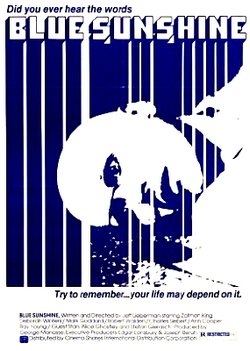 BLUE SUNSHINE, released in 1976, proved to be a successful blend of several bizarre and brilliant concepts that combine into a rare genre goulash that is both intellectually stimulating and deliciously exploitive. Eventual star of the soft-core serial RED SHOE DIARIES Zalman King is solid as Jerry, who took part in an "experimental LSD program" (in my day, we called that "Friday night") ten years previous while in college, and may ultimately be a victim of violent retroactive side effects that cause hair loss, delirium, aggression, and extreme homicidal tendencies. While he has not yet demonstrated these traits, others who took part in the experiments are most definitely falling into such patterns, which is hazardous to the health of any citizens who happen to be in the area when the shit goes down. The opening scene at a swingin' seventies shindig ends with one of the guests revealing their smooth, shag-less dome and killing another partygoer before taking off on foot and leaving Jerry in the role of undeserving suspect. As a result, he must go on the run himself in an attempt to find the people involved in the experiments, get to the bottom of things, clear his name, and try and figure out how to stop the process before he starts losing his luscious locks, the functions of his grey matter, and ultimately his freedom.
The problem for Jerry, however, is that some of his fellow test subjects have gone on to some pretty powerful positions. In particular, one of the President's bodyguards is beginning to show symptomatic tendencies, which not only gives him a leg up over our protagonists when things get hot, but creates a threat to national security, as he could turn on the Commander and Chief at any time. Aside from these problems, Jerry has to contend with the fact that seemingly anyone could turn from normal to nuts at any time, not to mention himself. The fact that Jerry is something of a ticking time bomb only adds to the tension, which is already palpable. BLUE SUNSHINE is one of those great seventies films where anyone could go at any time, leaving the viewer feeling uneasy, with the realization that no one, not even the main characters, are safe. With this in mind, one of the classic suspense sequences involves a former test subject who is babysitting the children of one character. As the scene wears on, and the woman begins to slowly demonstrate increasingly more evident symptoms, including a slippery grasp on her mental state and stringy pieces of hair sliding off of her head, the viewer grows increasingly more concerned. By the time she grabs hold of a kitchen knife and viciously pursues the children as the Jerry desperately attempts to wrestle her away from them, the scene has taken its place as an essential and volatile moment in not only Lieberman's oeuvre, but in the annals of 1970's genre fare. When all is said and done, BLUE SUNSHINE becomes the film that alerts the arrival of Lieberman as a strong member of the horror community. His next film, however, would be the one to lift him to the status of a true genre auteur.
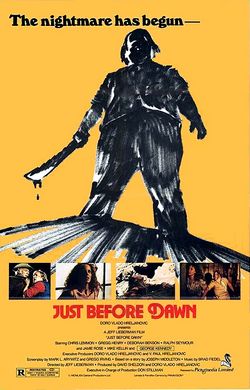
The early 80's were packed full of slasher films, after FRIDAY THE 13TH and HALLOWEEN set the standard and jumpstarted a craze that consumed both independents and the major studios. With films like PROM NIGHT, HALLOWEEN 2, FRIDAY THE 13TH PART 2, and plenty of other features coming from the majors, a film from more humble origins like JUST BEFORE DAWN could, and often unfortunately did become unfairly obscured and left without the support it deserved. Of course, this does not diminish the power and lasting effect of such a film. Any horror fans who have managed to pass over JUST BEFORE DAWN for whatever number of reasons needs to correct themselves and bear witness to what is unquestionably one of the top-tier survivalist/killer-in-the-woods slasher films ever committed to celluloid. This story of five friends versus oversized, deranged mountain men is still chilling to this day, and features a great score, gorgeous cinematography, and incredible locations. Despite the vastness of the area in which the film takes place, there is a feeling of claustrophobia that one simply cannot shake.
Chris Lemmon, Gregg Henry, Deborah Benson, Ralph Seymour, and Jamie Rose take to the Oregon mountains in a camper for a weekend of fishing, swimming, sightseeing, and, of course, drinking and illicit sexcapades. Before they arrive, though, an sauced-up old man and his chucklehead nephew stop at an old cabin while on a hunting outing and run afoul a gigantic grinning yokel with a rather nasty-looking serrated machete, undoubtedly the only example of such an implement of evisceration I have ever seen in the history of slasher films. After running the younger man through in a rather tender area - a moment which will have the males in the audience squirming in their seats - the aging drunk shows he still has some serious wheels when it matters, managing to high tail it back down the path with his limbs still intact. One could argue if they want that he is allowed to live in order to become the token "prophet of doom." His role, in essence, is to cross paths with the carefree youths and warn them of the dangers that lie ahead, so they can in turn ignore him, with the assumptions that he is just a drunken, crazy old bastard - which he is, but that doesn't makes his words any less pertinent. JUST BEFORE DAWN differs from other slashers in that it actually takes the time to show us how and why the prophet of doom slips into his role, rather than just lazily tossing him in as a cheap narrative vehicle.
When the group finally reaches their destination, things start to really pick up on a number of levels. Although a couple of the characters are knuckleheads, in particular the waif-ish, babbling Megan (Rose) - who can hardly put down her makeup kit and boom box long enough to gather a couple pieces of kindling - most of them are pretty strongly drawn. The token fifth wheel/prankster Daniel (Seymour) is not as grating as most of his contemporaries, and Jonathan, Warren and Constance (Lemmon, Henry, and Benson) are actually all quite good, their characters being far more mature and complex than the usual teen slasher fodder. George Kennedy actually receives top billing, but his story basically runs parallel with that of the group, intersecting only briefly in the beginning and again near the very end. He is a consummate pro, but he spends most of his screen time cooing jovially at his horse and riding her around pondering whether or not to search for the kids. It's a superfluous role, but Kennedy lends a presence to it that a lesser actor may not have been able to bring to the table. Secondly, the locations are cinematography are nothing short of breathtaking. Lieberman and his crew could not have possibly picked a more perfect spot to film, as there are a number of fantastic spots that play major roles in the film, including a steep rock face, a rope bridge, and a lake with accompanying waterfall. You really have to see it all to understand, but I cannot understate how the setting truly becomes another important character in the film, and Lieberman really knows how to wring the most out of it. The film may seem to some to be slow to get going, but if you are paying attention, there are plenty of clues throughout that the killers are constantly closing in, particularly through sound, like the distant whistling they use to communicate, which often goes unnoticed by the characters and maybe even the audience.
 There are a number of suspense set pieces that take place in broad daylight, which is a rarity in the slasher subgenre. One memorable scene in particular features Megan and Jonathan swimming in the aforementioned lake, with the towering waterfall looming in the background, leering at them almost as if it were a character unto itself. Lieberman utilizes deep focus and multiple focal points within the frame in this scene as a method of building suspense. As the couple make out in the foreground, the discerning audience member will notice a half-blurred figure emerging from behind the waterfall and submerging into the water. At the same time, Jonathan goes underwater, leaving Megan alone above the surface. Several moments go by, and tension begins to mount, both for Megan, who starts to wonder if Jonathan is okay, as well as for the viewer, who knows there is something coming for her, but does not know who or when. Suddenly, Megan feels hands on her legs and assumes that it is Jonathan playing games with her. After splashing about for a few moments, Megan notices out of the corner of her eye Jonathan emerging from the water on the far shore. It is at this moment that the terror for both Megan and the audience reaches its apex, as she realizes that it is a stranger beneath her trying to pull her under. She screams and struggles free, swimming over towards Jonathan and escaping danger. But this is a hollow victory for her, as the deranged mountain man has proven his ability to infiltrate her friends' space undetected, at least until it is too late. This is a technique that John Carpenter used to perfection in HALLOWEEN, and Bob Clark in BLACK CHRISTMAS before that. It is just one of a number of truly frightening sequences that catch the viewer off-guard simply because they takes place under the apparent safety of the midday sun.
Things really take a turn for the terrifying once the sun sets on the Oregon Mountains. By this point, once the group has been pared down to one surviving couple, the narrative takes an intriguing twist. Rather than have the heroine scream her fool head off and stumble around the woods waiting for her boyfriend or some lawman to show up and bail her out, it is the male figure who melts down and checks out mentally, leaving his girl to fight off the killer. And oh, man does she ever fight him off. After riding on his back like a cowgirl, hailing punches down on the back of his head, Connie manages to get the goliath of a mountain man on his back, at which point she throws one of the meanest right hands ever seen in a film - elbow deep into the poor bastard's esophagus, choking him out until he dies an ugly and undignified death. This may be one of the most inventive and brutal final kills in the history of the slasher subgenre. As is typically the case in the best horror films, there is no final moment where the resurrected killer jumps out for one final cheap scare. However, the simple image of the surviving couple in a dazed embrace as the sun comes up (giving actual weight to the film's title, for once) conveys the utter devastation of the moment, from which there will be no swift recovery. JUST BEFORE DAWN is definitely Lieberman's crowning achievement - a too-often passed over film that undoubtedly deserves to be listed among the eight or ten best slasher films ever made.
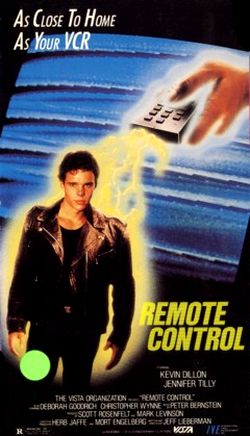
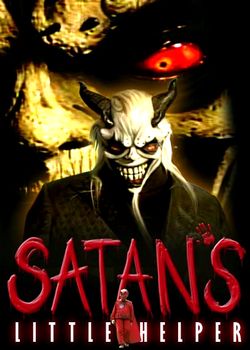 After JUST BEFORE DAWN, Lieberman took a sabbatical from filmmaking for several years, re-emerging only briefly to direct the minor cult hit REMOTE CONTROL, before seemingly retiring from the genre. Almost 20 years later, the director would make his comeback with the unique and highly entertaining SATAN'S LITTLE HELPER. It is safe to say that there has never been a film quite like this one. The film stars young Alexander Brickel as Dougie, an awkward, lonely kid who is obsessed with the video game "Satan's Little Helper." His older sister's boyfriend Alex persistently teases and picks on him, prompting Dougie to venture out in search of retribution on Halloween. Coincidentally, there is a vicious serial killer wandering the streets of Dougie's neighborhood dressed as Satan from the video game, and when the two cross paths, a partnership is born that will leave audiences either shocked or gleeful, depending on their disposition (read: if you are an uptight spinster who desperately needs to be offended by anything and everything that doesn't conform to your personal values system, you will find yourself shocked, however, if you are a horror fan who likes it when a film tries to push your buttons with over-the-top material and subject matter, than you'll be more than satisfied). Literally taking the role of "Satan's Little Helper," Dougie follows the killer as he slaughters his way through the neighborhood, and even encourages the silent psycho to off big sister's boyfriend. The thing is, Dougie is still a little kid when it comes down to it, and he actually believes that everything he is bearing witness to is an act, even marveling at times at how realistic the gore looks!
The killer, despite not speaking, is actually quite charismatic, making an art form out of mass murder; he arranges each of his kills to look like they are set up as decorative Halloween scenes. By the end of the night, the Satan Man has abducted Dougie's mother and taken her to a huge Halloween bash, at which time all Hell breaks loose. It is a testament to Lieberman's ability as a writer and filmmaker that, despite being a heinous killer, there is a sympathy built into the audience's mind for this villain as a result of his willingness to take Dougie under his wing and genuinely care for him as both an accomplice and a friend. But SATAN'S LITTLE HELPER isn't just about that mushy stuff - it's also full of spurting arteries and spilled entrails, as well as an effective sense of pitch-black humor. To date, this is Lieberman's last film, but it has achieved minor cult status, as his film's usually do, so those of us who have become devoted fans of his rock-solid genre output can be hopeful that he will continue to bring his unique brand of horror into our living rooms..
|
 dave
dave