We meet again. I hope you all enjoyed my first article—I’m very proud of it. With luck, doing articles for websites will become a usual for me and I can start doing this on a regular basis. Who knows what lies beyond this 4-part series?
Before we begin, let's do a recap. This whole thing started with Gojira in 1954, which got the ball moving for the Godzilla series. The series came to a screeching halt a year later with Godzilla Raids Again. Seven years later the series resumed when Godzilla vs. King Kong was released. From there, we had Godzilla vs. Mothra, Ghidorah the 3-Headed Monster, Invasion of the Astro Monster, Godzilla vs. Ebirah and Son of Godzilla.
As you can see, the films went from serious to more comedic over the years, appealing more to children and the young at heart. Here, in part two of the series, the stories really take a turn for the young, as Godzilla becomes the hero, often saving the day. Some of the films this time will also feature some of the most hated monsters ever, as well as some of the most loved. It's really amazing how diverse it gets.
Before we get into it, however, I feel it would only be fair to talk about some other non-Godzilla films and creatures. In particular, a creation by a fellow Japanese studio that has become Godzilla’s greatest rival...
Influence and Challengers
 It's not rocket science to know that if a film does great in a genre, that genre will grow as studios and directors try to subtly replicate the film. Godzilla did great and, sure enough, giant monsters started popping up everywhere, hoping to garner the same success. In the UK, they made Gorgo, the story of an undersea monster that longs to reclaim its offspring from the circus owner who stole it for his show. A Danish/American partnership made Reptilicus, a film about a serpent-like dragon that's released and wreaks havoc. America, as well, made several giant monster films, including The Black Scorpion, The Giant Claw and Behemoth the Sea Monster.
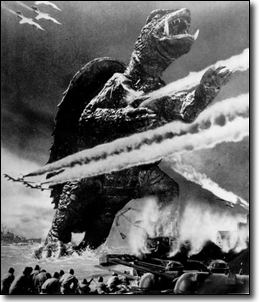
Toho also did several monster films outside of the Godzilla Series. They did King Kong Escapes—a direct sequel to their hit Godzilla vs. King Kong, the film has the great ape battling a mechanical twin years before Godzilla battled his robotic double (see below). They made Frankenstein Conquers the World, in which a boy discovers the radiated heart of the classic monster and, after eating the heart, grows to a size enormous enough to battle another Toho monster by the name of Baragon. Following Frankenstein was War of the Gargantuas—the Cain and Abel-esque story of two monster brothers. One film series, unlike all the other films, would grow into a series that would rival Godzilla's legacy and have fans debating which is better in an argument that still happens to this day. The company that would start this in 1965 was Daiei. At the time, Daiei was one of Japan’s biggest film companies, next to Toho. Their creation? Gamera, a Prehistoric Turtle.
The film is about an air battle between American and Russian Fighter jets in the Arctic. During the air battle, a nuclear blast occurs and awakens Gamera, a giant monster that can fly and both devour and shoot flames. It wreaks havoc on the world but finally is trapped in a space shuttle that sends him to space.
The film was designed for children, and the films that followed would continue that trend. Gamera vs. Barugon, Gamera vs. Gyaos, Gamera vs. Viras, Gamera vs. Guiron, Gamera vs. Jiger and Gamera vs. Zigra—most of the plots for these films involved Gamera coming to the rescue of children who are being threatened by whichever monster showed up that day. The first few films of the series, despite being cheesy, were enjoyed by the viewing public, but the quality of the films went downhill as they went along (as most series do). The final film of the Gamera Show Era—Gamera: Super Monster—was filled with stock footage of past monsters. The film was intended to save Daiei from its financial crises. It failed.
 Gamera would remain down and out for 15 years, until Daiei decided to do what Toho did (Godzilla's restart the Heisei Era) and reboot their monsters in 1995. This led to the making of the Heisei Gamera Trilogy. Unlike the past films, Gamera was more of an anti-hero, helping mankind but not to their liking. The films were also darker and less kid-friendly. Gamera's origins wrere finally explained: he was a Monster of Atlantis who was to defend the human race against any threats that should arise.
This series not only revived Gamera as a more serious monster, but also won over skeptical Godzilla fans who finally considered him a worthwhile monster. The trilogy also featured actress Ayako Fujitani, daughter of martial arts legend Steven Segal. And before you cringe, I assure you that, unlike her father, she visited acting class.
In 2006, they started what would come to be known as the Gamera Millennium Era, with its first (and only) film called Gamera the Brave. This film takes Gamera partly back to his Showa Roots, as it opened with Gamera in the 1970's, saving a village from a group of Gyaos (Gamera's greatest arch enemy in both Showa and Heisei Eras). The film then fast-forwards over 30 years when the son of a survivor finds a shell that becomes a Baby Gamera. Baby Gamera then defends the human race against attacks from a monster called Zedus.
This film, as mentioned, is the only film of this Era, and, since it wasn’t a financial success, that doesn’t look to change anytime soon. The recent Ultraman also didn't do too well in Japan, so it could be argued that giant monsters are going out of style right now, with the exception of the recent Cloverfield.
And if your wondering, "What would happen if we got Godzilla vs. Gamera?", well, we almost got it. In 2004, Daiei offered Toho the chance to combine their 2 icons in a film and have the big showdown. Alas, Toho said no. There's no question the film would have been as big (or bigger) as the famed Godzilla vs. King Kong, but even that film isn't the most loved (as mentioned in the Part 1). So while it would have been awesome to see the big showdown, there is a reason why it's better we don't.
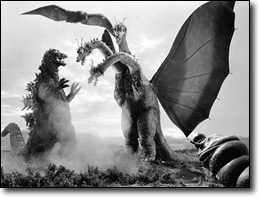
So there you have it, Godzilla's biggest rival. Even though it’s child-oriented for the most part, you should still check it out. There’s a wide range of monsters like in Godzilla, some more memorable than others. If the idea of watching kid movies turns you off, you might still want to see the Heisei trilogy, as it’s the most favored (similar to Godzilla Heisei).
Now that we have all that out of the way, it's time we get back to the timeline. This second half of the Showa Series is going to be….well, interesting. Some films are very similar to the Gamera series like above, while others come off as if you’re stoned (no joke). This time, there'll be 4 alien invasions and vengeance from the people underground. We'll also introduce mechanical monsters for the first time, a few growing to be fan favorites.
So, let's begin...
The Showa Era - Second Half
Destroy All Monsters (1968)
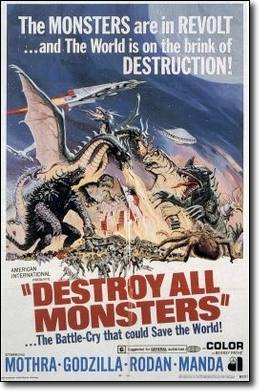 Monsters: Godzilla, Rodan, Anguiras, Gorosauras, Minnilla, King Ghidorah, Manda, Mothra (Larva), Kumonga, Baragon, Varan
Lowdown - Yeah, that's a lot of monsters. The reason this film had so many was that this would mark Godzilla's first “retirement” film. The last few films lacked in theater numbers and profits, so they figured why not put it to an end and, as the old saying goes, go out with a bang. Some of the monsters you'll clearly see are from past films, while others are from films Toho made outside of the series. And while the film is in the middle of the Showa era, it's actually at the end of the timeline as it is set in 1999.
The story here is that in 1999 (then the future), all the monsters have been moved to Monsterland, an island that holds them prisoner. A daily shuttle takes off for the lunar base and, after contact is lost with the base on Monsterland, Dr. Yoshida sends Captain Yambe and the crew of the SY-3 (the spaceship that travels to the moon) to investigate. Once there, they discover that the population is under the control of an alien race called the Kilaaks. They also learn that the Kilaaks have control of all the monsters and, unless the human race surrenders the earth, the monsters will destroy them all.
The movie is often mixed on reviews. It features a lot of action and battle sequences, with the monsters destroying a lot of classic locations (NYC, Beijing, Paris and Moscow). At the same time, some of the monsters featured were just there to be there—Baragon and Varan are barely in any scenes and don't partake in the final battle. And while this was meant to be retirement for Godzilla, the success had Toho making another film in less then a year.
All Monsters Attack (1969)
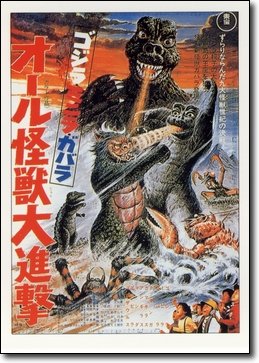 Monsters: Godzilla, Minilla, Gabara, Anguiras*, Gorosauras*, Manda*, Kumanga*, Giant Condor*, Ebirah*, Kamacarus*, Maneater
Lowdown - Now while you might get excited by the huge list of monsters, the * means that the scenes they're in is stock footage—pretty much just scenes from past films. So, in reality, what you see is nothing you haven’t seen before. Gabara, the new monster, is one of the most loathed monsters, looks almost like a cross between a cat and troll, has a horse-like laugh, and is, essentially, a monster version of a schoolyard bully. The Maneater is simply a plant that grabs the kid when he's dreaming.
The story this time doesn’t feature any real monsters. Really, it doesn’t. The film is about a boy who's lonely because he comes home everyday and empty house because his mom and dad are at work. Everyday on the way home, he’s bullied by Gabara and his group of friends. To escape, he imagines that he goes to Monster Island where all the monsters in the world live and talks to Minilla who also has a Gabara monster to deal with. The film also has the kid getting involved with two robbers.
If you're rolling your eyes at this plot, yeah, I can't blame you. The film is an obvious attempt to capitalize on Gamera's success with children. Put simply, if you’re 10 years old or younger, you'll love this film. Any older and you should simply get this to add to the collection.
Godzilla vs. Hedorah (1971)
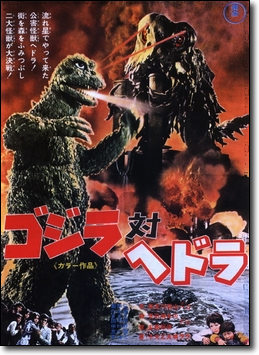 Monsters: Godzilla, Hedorah (Water, Land, Flying, Final Form)
Lowdown - This film is something totally different from the last one. I personally joke that it was funded with acid revenues because it almost looks like an acid trip. Director Yoshimistu Banno wanted to do an anti-pollution themed film and the result was Hedorah, a space monster that feeds on pollution. The film's weird cartoon scenes and bizarre editing left some of the original makers of Godzilla films outraged and they demanded that Banno kill the series.
The story is about a scientist that, with his family, discovers Hedorah when he is investigating the bad fishing. They, of course, warn the appropriate authorities. Thankfully, Godzilla shows up and, furious with the pollution levels, challenges Hedorah.
Unlike the last film that was made for kids, this time you might be reluctant to let them watch, as it features drinking, drugs and a woman in a painted skin suit dancing, plus rotted corpses from Hedorah's toxins. The movie's a fun time if you have a sense of humor. Also, this features an embarrassing moment for Godzilla when he flies using his radioactive breath.
|
Godzilla vs. Gigan (1971)
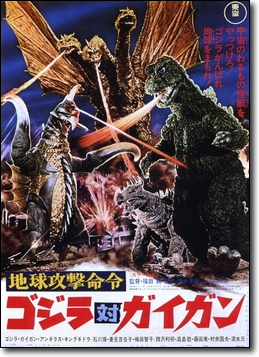 Monsters: Godzilla, Gigan, Anguiras, King Ghidorah, Mothra*, Rodan*, Kumanga*, Kumacarus*, Gorosauras*, Minilla*
Lowdown - Again, * means that they're stock footage, except this time it barely plays into the story. Past veterans Godzilla, Anguiras, and King Ghidorah return for the main part of the story. New space monster (and the first robot of the series) Gigan is introduced, as well. While he's often called a giant robot chicken because of his appearance, he was one of the more dangerous foes at the time due to the sharp claws he has for arms and the buzz saw going down his belly. This brings another first for the series as he doesn’t just make Godzilla and Anguiras bleed, but he makes the spill a ton of blood.
The story about cartoonist Gengo Kotaka, who is hired by a company called World Children's Land to design monster drawings for there theme park they're building with a Giant Godzilla tower in the center. Upon digging deeper, he and his friends discover the WCL are actually aliens plotting world domination. They then discover a tape by them and play it, which is heard by Godzilla and Anguiras all the way at Monster Island and decide to investigate.
The film is a real mixed bag that leans more to the negative side, since a lot of the acting is flat. Gigan, however, would grow to become a fan favorite for years. The film also features cartoon bubble words when the monsters talk to each other, though th US version uses real words. Either way, it's another embarrassing moment.
Godzilla vs. Megalon (1973)
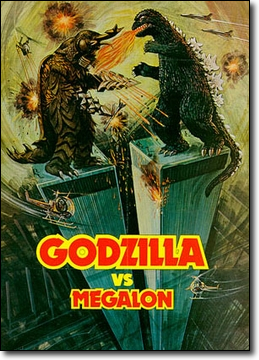 Monsters: Godzilla, Megalon, Jet-Jaguar, Gigan, Anguiras*, Rodan*
Lowdown – Brace yourself. As bad as the last few films have been, this one is by far one of the most hated Godzilla films ever. The two new monsters, Jet-Jaguar and Megalon, aren’t the most loved either. Jet-Jaguar, a man like robot, is viewed by many as a rip off of Ultrama, while Megalon, a giant Beetle God, has rather poor special effects and stock footage from past films was used for his power.
The film is about toymaker Goro Ibuki, his younger brother Rokuro and their best friend Hiroshi Jinkawa. Together they build Jet Jaguar, a man-like robot. An underwater race called Seatopia steals the robot and plans to use it to help guide their God (Megalon) to destroy the world above for disrupting their world. When the Seatopians learn that the people of above got Jet-Jaguar back and used him to get Godzilla on their side, they get the controllers of Gigan to send their monster to defend them.
You know how a lot of people joke that Godzilla films have bad special effects and cheap dubbing and lame monsters? Many blame this film for that. I've mentioned that past films have had embarrassing moments for Godzilla…this film has two. Not only does Godzilla shake hands with Jet-Jaguar, but he also does a running dropkick, lucha-wrestling style. Yeah, laugh.
Godzilla vs. Mechagodzilla (1974)
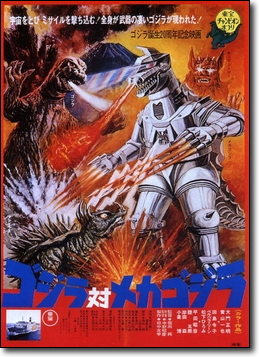 Monsters: Godzilla, Anguiras, Mechagodzilla, King Ceasar, King Ghidorah*
Lowdown - This one probably sounds familiar, as it's the first showdown between Godzilla and his robotic twin, Mechagodzilla. This film was made as a 20-year anniversary tribute to the first film. Mechagodzilla has one of the largest arsenals in Godzilla history. Also introduced is King Ceasar, who was inspired by the Okiwana myth of Shisa—a lion and dog combo that protects against evil spirits. Anguiras returns for the last time until the Millennium Era, a good 30 years later. This film does, however, show a bad trait of Toho’s, which is ripping off other famous films from the West. The aliens strongly resemble the apes from Planet of the Apes.
The story is based an ancient legend that when a black mountain is in the sky, an evil monster will ravage the land. Further, when the red moon sets and two suns rise in the east and west, two more monsters will rise and do battle with the previously incarnated black Mountain monster. When a black cloud that looks like a mountain is seen, Godzilla suddenly rises from under a volcano. The people sense that something isn't right when Anguiras, Godzilla's past partner, attacks him. It's learned later that the Godzilla unleashed is really a fake Godzilla (a Mechagodzilla!) and the real Godzilla comes to confront it. Mechagodzilla is controlled by aliens who want to rule the earth and the race is on to release King Ceasar from his rest so he can help Godzilla fight his evil twin.
So, did this anniversary film save the series from the abomination that was Godzilla vs. Megalon? Yes, it did, and it has grown to be a favorite of Godzilla fans. The special effects are, for the time, pretty impressive. Mechagodzilla is one of the few monsters that has been brought back in every era of Godzilla, like Mothra, Rodan, and King Ghidorah have. This does feature yet another embarrassing moment, though (they're common at this point of this Era), as Godzilla becomes Magneto almost, getting magnetic powers.
Terror of Mechagodzilla (1975)
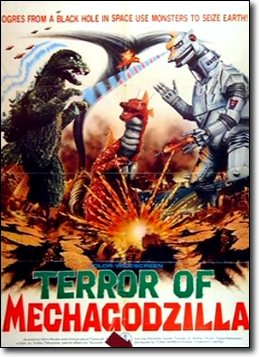 Monsters: Godzilla, Mechagodzilla II, Titanosaurus, Manda*, King Ghidorah*, Rodan*, King Ceasar*
Lowdown - This would mark many lasts for Godzilla. It marked the last time Ishiro Honda would direct a Godzilla film, the last time actor Akihiko Hirata played in a Godzilla film, the last tooth and claw monster for nearly three decades, and Godzilla's last film for nine years. Unlike the other films meant for his retirement, this wasn't intended to be one. This film introduces Titanosaurus in his first and only film, but that was enough to gain a cult following that persists to this day.
The plot for this film concerns Akira Ichinose, a biologist who must discover what happened to the submarine looking for Mechagodzilla's wrecked body. Upon hearing of the monster's roar when it was attacked, they look to Dr. Mafune who was viewed as a nut by the Institute and thrown out, but not before vowing vengeance. When they seek him, they find his daughter, Katsura, and she informs them that he's died. Later though, we learn that he's alive and can control Titanosaurus, and this has gained the interest of another wave of alien invaders who've recovered Mechagodzilla and plan to continue the previously unsuccessful attack.
The film, while enjoyable, is viewed by most as a step down from the previous film. Godzilla is barely the focus of the film and only shows up when need be. There is a rather intense battle scene as Godzilla and Titanosaurus's battle is very physical. Also, this features the first and only time breasts are shown during a surgery scene, but they're a fake prop, so don't get your hopes up.
So, there you have the first ever Era of Godzilla. From here, Godzilla would go on a near decade hiatus, not returning until 1984. But alas, that's not until Part 3, coming next month. Until then, I bid you farewell.
|
