
The Hammer House of Horror – perhaps second only to James Bond as the biggest cinematic export of the United Kingdom in the 1960’s. Their early releases The Curse of Frankenstein and, arguably even more so, Dracula - or Horror of Dracula, as it was renamed for international audiences to differentiate from the old (and inferior! Ooh, controversial) Universal version – rocked and shocked the establishment in the late fifties, dragging the classic gothic tales kicking and screaming into the Technicolor age. Thanks to their warts-and-all approach, and their good working relationship with some of Britain’s best actors of the time – most notably, of course, Peter Cushing and Christopher Lee - a humble English family business was soon on top of the world, conquering the box office in Europe, America and Japan. And unlike many other British film companies before and since, they were smart enough not to let success go to their head. Rather than blowing their new-found wealth on more extravagant productions, they maintained tight budgets and shot on the same locations, hence they were able to produce such a staggering amount of films from 1958 up to their last genre effort To The Devil A Daughter in 1976. However, by the end of the 60’s, along with unchanging budgets and locations came a creative stagnation. What had been shocking in the late fifties no longer held quite the same power with the likes of Rosemary’s Baby and Witchfinder General in the cinema. Yet it wasn’t simply a case of Hammer refusing to move with the times; their distinctive style was their selling point, and as such more Dracula was all the audiences (and financial backers) wanted to see. By 1970, however, Christopher Lee’s reluctance to continue reprising the role was growing all too apparent. Hammer needed something new, something different, yet not so new or different as to alienate the audiences who expected the gothic churches, misty woods and bulging bodices.
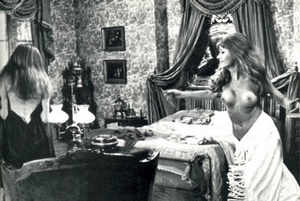 And they briefly found that alternative in the appealing shape of Mircalla Karnstein – otherwise known as Carmilla, from the novella by J Sheridan Le Fanu that predates Dracula by twenty five years. For a short time, she would become Hammer’s new superstar monster, in The Vampire Lovers, Lust For A Vampire and Twins of Evil.
It surprises me how few times Carmilla has been put to film; there are hardly any significant adaptations besides Roger Vadim’s earlier effort Blood & Roses (and if anyone knows where I can get a copy of that, do tell!). Dracula has long since grown so over-familiar that many adaptations go to such pains to make it their own, they wind up barely recognisable as Bram Stoker’s story – the John Badham/Frank Langella film, and the recent BBC adaptation with Marc Warren come to mind. As a less familiar story, Carmilla offers the opportunity to do classic gothic horror in a period setting with a degree of freshness.
And that, of course, is not the only thing that makes Carmilla an enticing prospect. There is the small matter of the titular antagonist taking the form of a beautiful, eighteen year old lesbian...
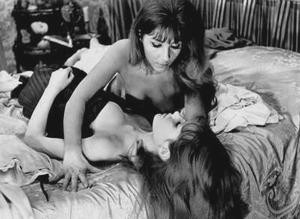 One thing we should be clear on from the start about the Karnstein Trilogy is that, in truth, it is nothing of the sort. The trilogy label is something that has been applied retroactively by film scholars/geeks (if there’s a difference?), given that three films were made based around the same central mythology. So far as I can tell that was not in any way Hammer’s plan (the absence of any further films owing mostly to the company’s failing fortunes, I suspect), and there isn’t a great deal linking the films in terms of narrative or character. But it’s an appropriate label insofar as the films share an explicit emphasis on sex that was new to Hammer, and epitomise what the company became in what would turn out to be its twilight years; the era when the key ingredients were, as screenwriter Brian Clemens put it, “blood, boobs and a good title.” And the Karnstein Trilogy certainly has those.
First, in 1970, came The Vampire Lovers, a direct and fairly faithful adaptation of Carmilla. Probably the finest of the trilogy, it is surely the most beloved thanks to the casting of one the most beloved scream queens of the era – Ingrid Pitt. With her regal presence, thick European accent and willingness to get naked when the scene called for it (as it invariably did), she was the perfect fit for the enigmatic young woman who slyly worms her way into the household of a well-to-do widower and – but of course - his virginal daughter. Whereas many of Hammer’s leading ladies are often a bit stiff and awkward, Ingrid Pitt is so at ease she’s almost laconic, bringing the required animal magnetism with very little visible effort. There’s no mistaking that she’s a worldly woman who knows what she wants; contrast that with the doe-eyed innocence of Madeline Smith’s coy and inexperienced Emma, and it’s a potent cocktail indeed. Look no further than the tantalising bathtub scene, culminating in the topless Pitt playfully chasing the similarly attired Smith around the bed. Grrrr. Of course sex appeal was not new to Hammer – Christopher Lee was always something of a supernatural stud, and all his victims heaving bosomed babes – but never before had things got quite this spicy or revealing. And as if all that wasn’t enough, when Pitt gets her bite on, she doesn’t go for the neck, but the breast.
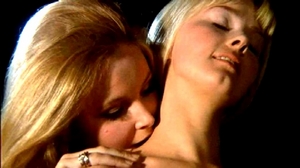 It seems likely to me that a big part of why Mircalla is not as synonymous with Hammer as Dracula is that Ingrid Pitt sadly never reprised the role; partly due to filming commitments on Countess Dracula, but also for script quality concerns. Few could blame her, I suppose. But for all Lust For A Vampire lacks in intellectualism (i.e., shitloads), it more than makes up for in sheer lurid novelty. Just get this for a premise: gorgeous, bisexual vampiress... in an all-girl’s boarding school. The mere thought brings a smile to the face, to say nothing of other physical responses.
Made and released within the same year as Lovers, Lust doesn’t bother with any direct references to the previous film. Resurrected in the blonde and buoyant form of Yutte Stensgaard, Mircalla enters an exclusive educational institute on a country estate, populated almost entirely by similarly buoyant young women who study in low cut diaphanous dresses, run around the school grounds giggling, and have no qualms about sitting in their dorm rooms topless after dark. It’s a dirty old man’s dream come true, and there are more than a couple of dirty old men around, one of whom worms his way into a teaching position motivated purely by his interest in Mircalla (the titular lust). Stensgaard may be plenty desirable, but she lacks that distinct animal quality that Pitt brought to the role; she’s softer, less threatening, sexy but never remotely scary. Though she does have a nice trick in going fluttering her eyelids and going a bit cross-eyed when in the thrall of the vampiric/orgasmic rapture.
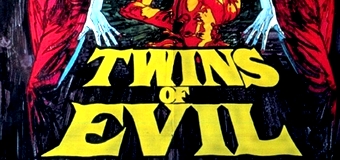
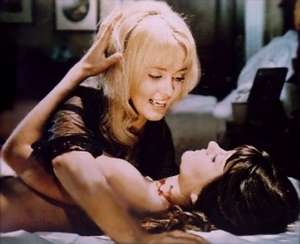 So - from a sequel of sorts to a prequel of sorts. Now, because of that uniform quality that Hammer films have – the sense that, to a degree, if you’ve seen one you’ve seen them all – it’s not uncommon to find that some adore the ones others dismiss. Quality is rarely a factor in this. In Sinclair McKay’s book A Thing of Unspeakable Horror, he summarily lists all the reasons Dracula AD 1972 sucks – then promptly admits it’s his personal favourite Hammer! As such, it’s not surprising that while McKay has little regard for Twins of Evil, it’s the one I’m most fond of. It was one of the first Hammers I saw, and when you’re just hitting puberty it’s the kind of film that sticks with you. It’s not so surprising that Ingrid passed on reprising Mircalla here, as she shows up in only one scene - and it doesn’t even involve girl-on-girl action (indeed, Twins is the straightest and most skin-light of the trilogy). That said, it is a fairly perverse cameo, as she is resurrected by her descendant Count Karnstein – with whom she proceeds to get down. Yes – this is presumably her grandchild/grandnephew or thereabouts. Not that this occurred to me on first viewing, and I can’t help suspecting it didn’t occur to those making the film either. In any case, it’s pretty much Mircalla in name only; Katya Wyeth is foxy but nondescript, lacking the charisma of Pitt or even Stensgaard. But she sure knows how to gives a candlestick a handjob.
The real stars of Twins of Evil are of course the titular sisters Freida and Maria, as portrayed by Mary and Madeleine Collinson, the first twin Playboy centrefolds. (Did Hammer know a selling point when they saw it, or what?) Orphaned, they come to live with their Uncle Gustav Veil, a staunch puritan and leader of a brotherhood whose principal evening pastime is hunting down suspected witches and burning them at the stake. While physically identical, the girls are mirror opposites personality wise: where Maria is shy, obedient and chaste, Freida is outspoken, rebellious and, you guessed it, horny as hell. This rambunctious temperament leads her to seek audience with the infamous Count, known for his devilish debauchery but protected from Veil’s brotherhood by his influence with the Emperor (more class relations issues!). Having been sired by Mircalla, the Count in turn sires Freida; and never before is Maria less grateful to be constantly mistaken for her sibling.
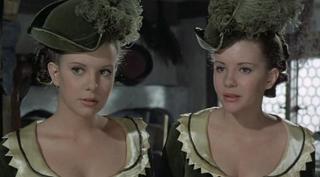 It doesn’t really surprise me that Twins of Evil is largely disregarded in the Hammer pantheon; it’s not the most sophisticated plot-wise, and does hinge pretty heavily on the hot twins gimmick. But it gives Cushing one of his best roles outside of Baron Frankenstein and Van Helsing. Veil clearly takes cues from Vincent Price’s Mathew Hopkins of Witchfinder General infamy, and yet in Cushing’s masterful hands he remains a sympathetic character. Not many actors could make us believe that a murdering religious extremist really does mean well, but with Cushing in the role we really do believe, as David Warbeck’s character says, “he may be misguided, but he’s a good man.”
On top of which... hot twins may indeed be a gimmick, but what a gimmick! The Collinsons are truly gorgeous squeezed into their corsets. As the bad twin, Freida (Madeleine, apparently) gives us the most entertainment value; look no further than the moment she eavesdrops as Veil rants about Karnstein’s diabolical orgies, and the way her eyes light up at the words “men and women stripped naked!”
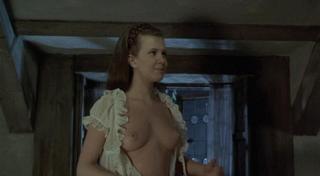 I know I’ve emphasised the sexual content of these films, and that is what they are mostly remembered for. Even so, it would be wrong to dismiss The Karnstein Trilogy as no more than nudie cuties. They are among the few Hammer Horrors to give substantial leading roles to women. They carry that timeless mystical quality associated with all the best Hammer productions, along with sly undertones of the social and sexual movements of the time. And, it must be said, while they may have been considered pretty full-on for the time, they’re really quite tame by modern standards. But in this day and age when your average kid can access more hardcore porn in a minute on the internet than their parents could in their entire adolescence, there’s a definite sentimental appeal to the more teasing imagery of these movies. Lingering glances; heaving décolletages; Ingrid Pitt stripping in silhouette as Kate O’Mara dims the light. There’s something to be said for that old-fashioned approach to titillation, when the thrill came as much from suggestion, and young men’s eyes stayed peeled for the whole ninety minutes to ensure that not a single fleeting bare breast was missed.
Not that there’s nothing to be said for full frontal close up hardcore, but still.
|
 by:
by: