 the judges and the saints and the textbook committee
decided you should be left out
not even mentioned
-Guided By Voices
In 1776, a fancy pants Scot named Adam Smith published a book titled, An Inquiry into the Nature and Causes of the Wealth of Nations. Aside from being the foundation of nearly all economic theory, the book worked to explain that a free market is the most beneficial of market structures. The theory is that every participant within any market is an actor. Each actor makes decisions with respect to their own best interests. With that in mind, when left alone, an “invisible hand” will control and prevent inefficiencies within a free market. This is where the idea of laissez-faire (let do) comes in. Let the actors play their roles of their own accord, and all will be well.
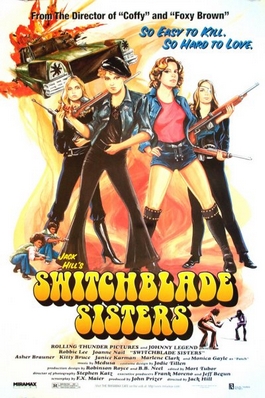
In keeping with the theories set forth by Smith, Switchblade Sisters is the most conservative exploitation movie, ever.
In this Shakespearean best-coast response to A Clockwork Orange, we find that Los Angeles has descended into a cesspool of violence. The police have all but given up in fighting. Street gangs prowl with impunity. And the citizens are at the behest of these young rouges. This scenario has been depicted in countless movies. What's unique about Switchblade Sisters is the dynamic it presents. There's an obvious fear and vulnerability that the gangs instill in the people around them as they attempt to live ordinary lives. Instead of making the youth into primordial thugs as in Deathwish 3, or painting their faces and turning them into sex-starved hedonists like Jubilee, Switchblade Sisters creates a community of gang culture that regulates itself. Civic and community organizations are maintained by way of gang force. Unfair business practices are made disadvantageous through brutality. Returns from prostitutes are maximized based on allotted time, and monopolies on the drug market are unwanted; competition is preferred.
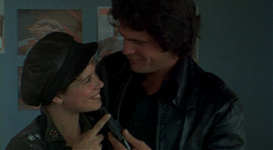 We follow the exploits of the Silver Daggers led by Dominic (Asher Brauner) and their sister, all-girl variant, the Dagger Debs. The gangs are well-known and feared wherever they go. The acting matriarch of the Debs is Lace (Robbie Lee) - a girl whose overbite and clarion voice lend to her juvenile aura that works as a perfect inverse to her pugilism. (Is it still pugilism if it's not with fists, but a switchblade? Fuck it. I'm using the word anyway.) Dominic and Lace share a lopsided romance, with Lace doting over the visibly apathetic Dominic. As the alpha of their groups, it only makes sense that the two form the crown of this violent monarchy.
In the Dagger Debs first moments on-screen, we see them take revenge on a repo man who has threatened the last thirty dollars from a single mother of two. Moments later they're celebrating at a burger shack with their male counterparts. There, Lace's second-in-command, Patch (Monica Gayle - who writer/director Jack Hill describes as the Iago in this Othello. Along with Friga from Thriller! They Call Her One Eye, Patch is the obvious influence of Darryl Hannah's Elle Driver in Kill Bill!), confronts a fresh-faced girl who refuses to vacate her table for the Debs.
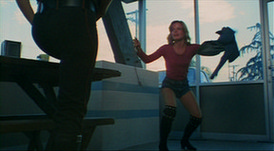 Enter Maggie.
Within seconds, Patch is on the ground with her own switchblade - a representation of her identity - taken from her. The group is now intrigued by Maggie (Joanne Nail) whose ferocity is equaled by her beauty. None more than the leader of the Silver Daggers. Dominic's theory on love is born of the Howard Roark/Behind the Green Door School of romance. To pitch woo is to force yourself atop the girl of your want. Why does Maggie, who has established herself to be a woman of strength, allow such a savage brute to befoul her? In literature, as in life, as in this movie, men make women stupid. The same way Dominic is able to use her for his seminal release is the same way the rational woman of Hemmingway’s Hills Like White Elephants is talked into terminating her pregnancy. Men traditionally write women as creatures who succumb rather than fight. It's this yield to an erroneous, ill-conceived, gender norm that works as the movie’s major fault. It’s the sour note in this aria. Otherwise, Switchblade Sisters could have been the Patti Smith of 70’s cinema. (Though, it should be admitted that this author believes the antiquated notion that this planet would be the most tranquil of places were the sole inhabitants women. If it were occupied only by men, we would spend most of the day masturbating into fire.)
|
|
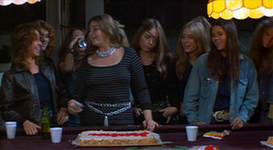
Gee, which one do you think suggested cake?
|
We, the audience, learn little about Maggie's background. Her ability and lack of allegiance for any of the other rival gangs are never source for discussion. Instead, through a series of events, we watch as she finds herself usurping Patch and rising in the ranks of the Dagger Debs as Lace's Second-in-Command. This creates a rift, leading Patch to plant the seeds of doubt in Lace's head. The tides turn for Maggie. She's pitted against the same figures that brought her into the Dagger Debs.
What follows is a web of deceit, treachery, and violence. Jack Hill's work is pure dime-novel pulp, but it's executed so well. It's relentless in its beat, never yielding like so many low-budget exploitation flicks tend to. Where those movies meander along, almost daring the audience to stay awake, Switchblade Sisters operates at a fever-pitch. Its meter is like that of a drunken pianist, bleeding at the fingers. Furthermore, its intelligence places it on par with some of the great social commentaries. In constructing an agency of gangs that protect their own turf, and operate with some greater motive - a catalog of dynamic characters are created. For the all-black Panther women, it's a refusal of assimilation. For the crabs, its gaining majority share of the drug cartel. They want what's best for them. It's this want that keeps civilization in tact. Otherwise, what purpose would any order serve?
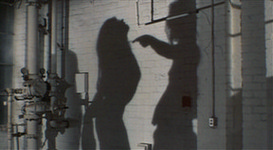 To explain the plot in any greater detail is a feat unto itself. The events which transpire would be laborious to trace through. Also, I'm at work right now and my dickhead boss is looking right at me. Instead, know that Switchblade Sisters is what the b-movie enthusiast sifts for. An intelligent movie, with great dialogue, that leaves any audience impressed. Too often, we sit through low-budget trash, forcing ourselves to enjoy it on some ironic level. In those, boredom is broken only by some punctuation of action. Resuming it’s dreadful pace thereafter. Bronson shoots. Dudikoff kicks. Jan-Michael blows something up.
Switchblade Sisters maintains the manic energy of those moments throughout its entirety.
|